



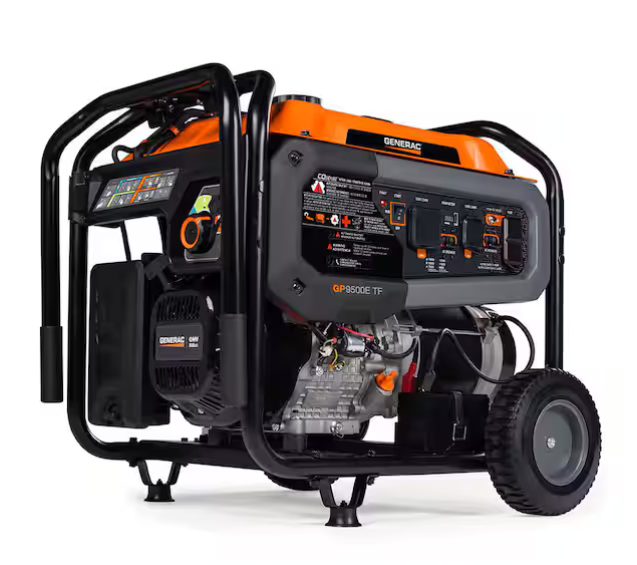
12500/9500-Watt Tri-Fuel Portable Generator, Easy-To-Use Electric Start, Wheel and Handle Kit Included
- AC Rated Output Running Watts 9500 (Gas) / 8550 (LP) / 7000 (NG) AC Maximum Output Starting Watts 12500 (Gas) / 11250 (LP) / 9000 (NG) Capable of running on gasoline, liquid propane or natural gas fuel source with the simple turn of a dial, this portable generator offers power, flexibility and reliability. Anytime, anywhere. With 12500 starting watts and 9500 running watts (Gas), the GP9500E Tri Fuel is simple to use, durable and easy to move in an emergency, around your next home project or wherever else you need it most. Onboard COsense technology provides powerful protection from hazardous carbon monoxide and the 500cc Generac OHV engine with EFI Technology provides consistent power for multiple applications, while a 7.5 gal. fuel tank delivers up to 10.5-hours runtime at 50% load (Gas).
- Highlights
- Tri fuel – runs on gasoline, liquid propane and natural gas fuel for your convenience
- .5-hour runtime when running on gasoline and 5-hour runtime on 20 lb. LP tank when 50% of power is being used
- Easy-to-use electric start – rocker switch provides reliable and hassle-free start ups (battery included)
- Efficient ohv engine – 500CC OHV engine with Effi technology optimizes fuel efficiency and requires less maintenance
- LP connector hose included – 4 ft. LP tank connection
- Handle and wheel kit – ergonomic handle and never-flat wheel kit included for portability
- 1 ¼ in. steel-tube cradle for added durability and strength
- Covered outlets provide added protection from the environment and rugged working conditions
- Low-oil level shutdown automatically safeguards engine from damage
- Cosense technology – stops, alerts, saves, powerful protection against hazardous carbon monoxide
- HomeLink manual transfer switch compatible designed to work with HomeLink manual transfer switches for safe home backup power
$1399.00
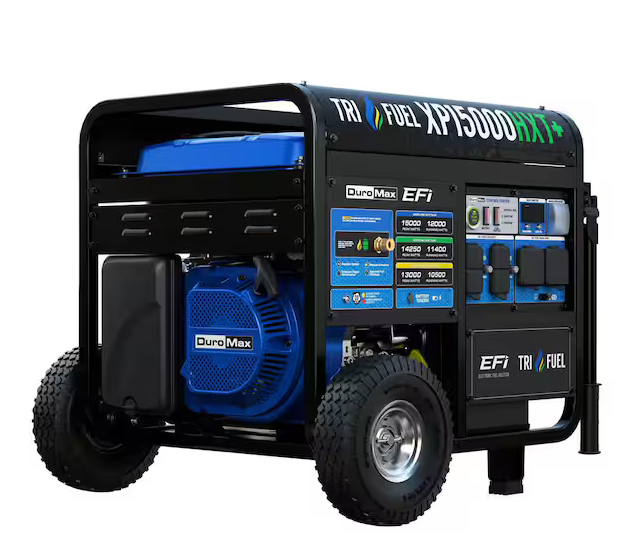
15000-Watt /12000-Watt Remote Start Tri-Fuel EFI Gasoline Propane Natural Gas Power Portable Generator 50 States
- Electronic Fuel Injection (EFI) – Maximizes fuel efficiency and ensures 50-state compliance. Clean Copper Windings – Produces less than 5% Total Harmonic Distortion (THD) for safe, stable power. AGM Gel Battery Technology – Delivers longer lifespan and enhanced cold-weather performance. Tri Fuel Capability – Runs on gasoline, propane, or natural gas for ultimate flexibility. High Performance Output – Built for serious backup with 15,000 peak watts. 50 State Approved Emissions – Safe for sale and use in California.
- Highlights
- Electronic fuel injection (efi) – maximizes fuel efficiency and ensures 50-state compliance
- Clean copper windings – produces less than 5% total harmonic distortion (thd) for safe, stable power
- Agm gel battery technology – delivers longer lifespan and enhanced cold-weather performance
- Tri fuel capability – runs on gasoline, propane, or natural gas for ultimate flexibility
- High performance output – built for serious backup with 15,000 peak watts
- 50 state approved emissions – safe for sale and use in California
$3,499.00
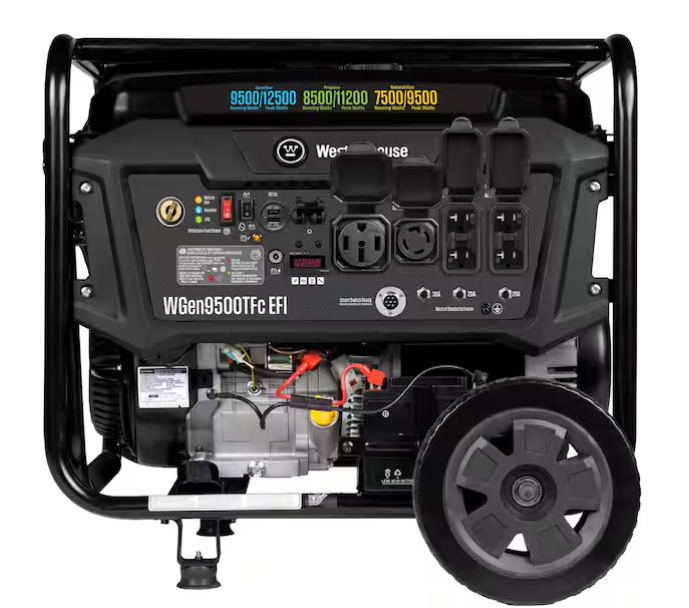
12,500/9,500-Watt Tri-Fuel Gas, Propane, Natural Gas Powered EFI Portable Generator, Remote Electric Start, 50A Outlet
- Highlights
- Fuel flexibility for home, RV and work: 12,500 peak watts, 9,500 running watts (gasoline); 11,200 peak watts, 8,500 running watts (propane) 9,500 peak watts, 7,500 running watts (natural gas) runs for up to 15 hours on a 6.6 gal. fuel tank with built-in gauge, starting: remote, electric and recoil
- Multiple outlets for many uses: features one 120/240v 14-50r 50a outlet for home or rv and one 120v l14-30r 30a twist lock both outlets are transfer switch ready for home backup. includes two gfci 120v 5-20r 20a duplex household outlets. all include rubber covers for added protection
- Durable engine with safety built-in: equipped with 457cc westinghouse 4-stroke ohv engine with durable cast iron sleeve automatic low oil shutdown co sensor for added safety digital hour meter for easy maintenance tracking
- Advanced efi: makes starting a generator as easy as starting a car, no choke or carburetor to deal with it delivers higher power and torque, reduces fuel use and emissions, increases reliability, and needs less maintenance carb compliant in all states
- Power you can trust: all westinghouse generators are functionally tested at the factory and may contain minimal residual oil or fuel odor and are backed by a 3-year limited warranty and our nationwide westinghouse customer service network
$1,449.00
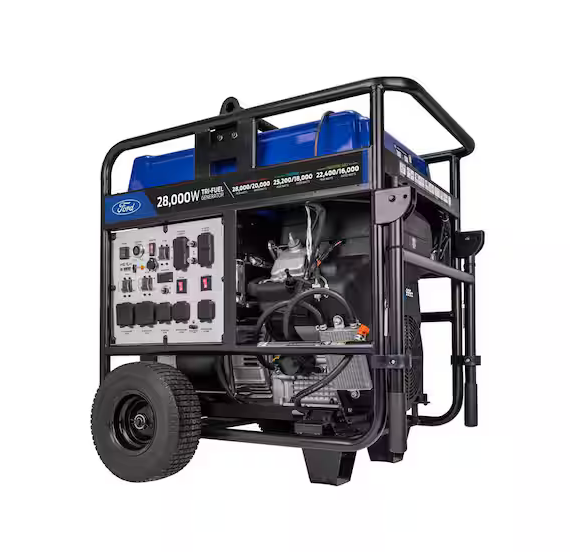
28000-Watt Electric Swich and Remote Start Tri-Fuel Gasoline and Propane Portable Generator, w/ CO Sentry
- Highlights
- Tri-fuel capability: operates on gasoline, propane (LPG), or natural gas (NG) for maximum fuel flexibility in emergencies or off-grid conditions
- Massive power output: produces 28,000 peak / 20,000 running watts on gasoline, 25,200/18,000 on propane, and 22,400/16,000 on natural gas capable of powering whole homes, heavy machinery, and commercial-grade tools
- 999cc V-twin engine: designed for long-lasting performance with reduced vibration and high torque for steady, reliable operation under heavy loads
- ATS ready: compatible with automatic transfer switch controllers for seamless backup power during outages
- Electric and remote start: fire up the generator with the push of a button or the included remote
- Comprehensive outlet panel: includes four 120V 20A GFCI outlets, two 120/240V 50A receptacles, two 120/240V 30A twist-locks, one 120V 30A twist-lock, and a 5V USB-A port all with protective dust covers
- 3-in-1 digital meter: displays voltage, frequency, and runtime hours for real-time monitoring and maintenance planning
- Heavy-duty portability: includes no-flat tires, fold-down handles, and a lifting bar for easy transport and secure positioning
- Complete accessory kit: comes with sealed lead-acid battery, propane and natural gas hoses, engine oil, funnel, and remote control
$3,375.32
How I Discovered the Flexibility of Multi-Fuel Power and What You Need to Know Before Buying
I’ll never forget the night the power went out during last winter’s ice storm. There I was, sitting in the dark, watching my neighbor’s house glow like a beacon while mine turned into an icebox. That’s when I decided enough was enough—I needed backup power, and I needed it to be reliable, versatile, and ready for anything. After months of research, testing, and more than a few headaches, I discovered the world of tri-fuel generators, and let me tell you, it’s been a game-changer.
What is a Tri-Fuel Generator, and How Does It Work?
When I first heard the term “tri-fuel generator,” I thought it sounded like some kind of science fiction contraption. But the concept is actually beautifully simple and incredibly practical. A tri-fuel generator is essentially a power generation unit that can run on three different fuel types: gasoline, propane, and natural gas. Think of it as the Swiss Army knife of backup power solutions.
The magic happens in the engine’s fuel delivery system. Unlike traditional generators that are married to a single fuel source, tri-fuel models come equipped with multiple fuel intake systems and a switching mechanism. The engine itself is designed to handle the different combustion characteristics of each fuel type. When you’re running on gasoline, the fuel flows through a carburetor or fuel injection system just like a regular generator. Switch to propane or natural gas, and the system adapts to handle these vaporous fuels, which burn cleaner and require different air-fuel ratios.
The beauty of this setup became crystal clear to me during my first power outage after getting my tri-fuel generator. I started on gasoline because it was what I had readily available, but when I realized the outage might last days, I switched to my propane tanks. The flexibility gave me peace of mind I’d never experienced before.
What Are the Best Tri-Fuel Generators Available?
After diving deep into the market, I’ve discovered that not all tri-fuel generators are created equal. The landscape is populated by both factory-made tri-fuel units and converted models, each with their own advantages.
Champion Power Equipment has earned my respect with their factory tri-fuel models. Their 7500-watt and 9375-watt units are workhorses that I’ve seen perform reliably in real-world conditions. What impressed me most was the smooth fuel transition system—switching between fuels feels almost effortless.
Westinghouse entered the tri-fuel arena with serious intent. Their larger models, particularly the 12,000-watt units, pack enough punch to handle whole-house backup needs. I’ve observed these generators handling heavy loads without breaking a sweat, and their build quality suggests they’re in it for the long haul.
DuroMax offers some compelling options in the mid-range power category. Their tri-fuel generators might not have all the bells and whistles of premium brands, but they deliver honest, dependable performance at a price point that won’t make your wallet weep.
For those willing to go the conversion route, companies like U.S. Carburetion and GENERACStore offer excellent tri-fuel conversion kits that can transform existing dual-fuel generators into tri-fuel powerhouses. I’ve helped friends install these kits, and when done correctly, they perform just as well as factory models.
How Does a Tri-Fuel Generator Differ from a Dual-Fuel Generator?
This question haunted me for weeks when I first started my research. The difference seems obvious on the surface—tri-fuel runs on three fuels while dual-fuel runs on two—but the implications run much deeper.
Most dual-fuel generators operate on gasoline and propane. They’re excellent machines in their own right, and I actually started with one before upgrading. The limitation I discovered was during extended outages when gasoline became scarce and my propane tanks eventually ran low. That third fuel option—natural gas—became my lifeline.
A tri-fuel generator adds natural gas to the mix, and this changes everything. If you have access to a natural gas line (and I eventually had one installed specifically for this purpose), you essentially have an unlimited fuel supply. The gas company keeps delivering, and your generator keeps running. It’s the ultimate insurance policy.
The mechanical differences are also worth noting. Tri-fuel generators require more sophisticated fuel management systems. They’re slightly more complex, which initially worried me, but modern designs have made this complexity virtually transparent to the user. The added versatility far outweighs any minimal increase in mechanical intricacy.
What Fuels Can Be Used in a Tri-Fuel Generator?
Let me break down each fuel option based on my hands-on experience with all three:
Gasoline is the fuel most of us are familiar with. It’s readily available at any gas station, packs a powerful energy punch, and gets your generator running with minimal fuss. I keep about 20 gallons stored (properly stabilized, of course) for immediate use during outages. The downside? Gasoline degrades over time, can gum up your carburetor if left sitting, and requires careful storage due to flammability concerns.
Propane has become my go-to fuel for most situations. It stores indefinitely, burns cleaner than gasoline (meaning less maintenance), and is available in various tank sizes. I maintain both 20-pound portable tanks and a 100-pound stationary tank. The fuel stability alone makes it worth considering—I’ve used propane that’s been sitting for over two years without any issues.
Natural gas is the unsung hero of the tri-fuel trinity. If you’re connected to a municipal natural gas line, you’ve got virtually unlimited runtime potential. The fuel is already at your property, there’s nothing to store, and you’ll never run out during an extended emergency. The trade-off is slightly reduced power output compared to gasoline, but for most applications, this difference is negligible.
Are Tri-Fuel Generators Worth the Investment?
I’m going to be completely honest with you—tri-fuel generators typically cost 20-40% more than comparable single-fuel models. When I first saw the price tags, I experienced serious sticker shock. A quality 8,000-watt tri-fuel generator can run anywhere from $1,200 to $2,500, depending on features and brand.
But here’s what changed my perspective: versatility has real, tangible value. During the propane shortage that hit our area two winters ago, I watched neighbors scrambling to find fuel for their dual-fuel generators while I simply switched to natural gas. That flexibility paid for the price premium right there.
Consider the total cost of ownership, not just the upfront price. Tri-fuel generators burn propane and natural gas cleaner than gasoline, which means less frequent oil changes, fewer spark plug replacements, and reduced carbon buildup. Over five years of ownership, I’ve saved hundreds in maintenance costs compared to my previous gasoline-only generator.
The peace of mind factor can’t be quantified in dollars, but it’s real. Knowing I have three different fuel options means I’m prepared for virtually any emergency scenario. Whether it’s a hurricane that disrupts gasoline supplies, a winter storm that limits propane delivery, or an extended grid failure, I’ve got options.
How to Switch Between Fuels on a Tri-Fuel Generator
When I first got my tri-fuel generator, I was intimidated by the fuel switching process. Would it be complicated? Would I damage something if I did it wrong? Turns out, modern tri-fuel generators have made this process remarkably straightforward.
Here’s my step-by-step process, refined through dozens of fuel switches:
First, I always let the generator run until it completely exhausts whatever fuel it’s currently using. This prevents fuel mixing and potential carburetor issues. I simply turn off the fuel valve and let the engine burn through what’s in the lines until it sputters to a stop.
Next, I make sure the engine has cooled down—I usually wait at least 15 minutes. Working around hot engine components is both uncomfortable and potentially dangerous.
Then comes the actual switching. Most tri-fuel generators have clearly labeled fuel selector valves or switches. I move the selector to my desired fuel source. On my Champion model, it’s a simple three-position valve. On converted units I’ve worked with, it might involve opening one valve while closing another.
Before starting on the new fuel, I always double-check connections. For propane, I verify the tank valve is open and connections are tight. For natural gas, I confirm the supply line is connected and pressurized. For gasoline, I ensure there’s adequate fuel in the tank and the fuel valve is open.
Finally, I start the generator according to the manufacturer’s instructions for that specific fuel. Some fuels require slightly different starting procedures—natural gas, for instance, sometimes needs a few extra cranks to prime the system initially.
The entire process takes me less than five minutes now, though my first few switches took considerably longer as I nervously double-checked everything.
Can a Tri-Fuel Generator Power an Entire House?
This was my primary concern when shopping for a generator. I didn’t want to just power a few appliances—I wanted whole-house capability, or at least close to it.
The answer depends on two factors: your home’s power requirements and your generator’s capacity. I mapped out every essential circuit in my 2,200-square-foot home: refrigerator, freezer, furnace, well pump, some lighting, and a few outlets for devices. My calculations showed I needed about 7,000 running watts with surge capacity up to 9,000 watts.
My tri-fuel generator produces 7,500 running watts and 9,375 starting watts, which gives me comfortable headroom. With a transfer switch properly installed (and I cannot stress enough how important professional installation is here), I can power everything essential in my home.
However, I had to make compromises. I can’t run the central air conditioning and electric dryer simultaneously with my setup. During summer outages, I choose between comfort and laundry. For most people, a generator in the 8,000 to 12,000-watt range will handle essential home needs, though larger homes with electric heating or cooling may need more capacity.
The fuel type also affects output. On natural gas, my generator produces about 10% less power than on gasoline. It’s still enough for my needs, but it’s something to factor into your calculations. I actually bought one size larger than I thought I needed specifically to account for this difference.
How Fuel-Efficient Are Tri-Fuel Generators?
Fuel efficiency was an area where I had to adjust my expectations and learn some hard truths. Tri-fuel generators, like all generators, aren’t exactly sipping fuel like a hybrid car. They’re working hard to convert chemical energy into electrical power, and that process has inherent inefficiencies.
That said, I’ve been pleasantly surprised by the efficiency differences between fuel types. Propane has proven to be the most economical choice for me in most situations. At 50% load, my generator consumes about 1.5 gallons of propane per hour. That might sound like a lot, but propane’s stability and clean-burning properties mean I’m not wasting fuel to carburetor deposits or degraded gasoline.
Gasoline consumption runs higher—approximately 0.75 gallons per hour at 50% load. Gasoline packs more energy per gallon than propane, but it also creates more carbon deposits and requires more frequent maintenance. The real efficiency killer with gasoline is degradation. I’ve had to dump old, stabilized gasoline that still went bad, which is essentially throwing money away.
Natural gas presents a different calculation entirely. I pay by the cubic foot, and my generator consumes roughly 150-200 cubic feet per hour depending on load. In my area, this translates to about $2-3 per hour of operation, making it competitive with propane and more convenient since there’s no refilling.
The load factor matters tremendously. Running my generator at 25% capacity wastes fuel—generators are most efficient at 50-75% of their rated load. I learned to stagger my power usage, running heavy appliances in rotation rather than all at once, which significantly improved my overall fuel efficiency.
What is the Runtime of a Tri-Fuel Generator on Propane, Gasoline, and Natural Gas?
Runtime quickly became my obsession after my first extended outage. Knowing exactly how long my fuel would last brought enormous peace of mind during uncertain situations.
With gasoline, my 8-gallon tank provides approximately 10-11 hours of runtime at 50% load. That’s a decent stretch, but it means I’m refilling roughly twice a day during extended outages. The advantage is quick refueling—I can have fresh gas in the tank in under five minutes. The disadvantage is having to actually do it, often in the dark, possibly in bad weather.
Propane runtime depends entirely on tank size, which gave me flexibility I deeply appreciate. A standard 20-pound tank runs my generator for about 5-6 hours at 50% load. My 100-pound tank extends that to 25-30 hours. I’ve daisy-chained tanks together using a proper manifold system, giving me days of continuous runtime without interruption. The convenience factor here is huge—I can swap out an empty 20-pound tank in seconds without shutting down the generator.
Natural gas runtime is theoretically unlimited, constrained only by your generator’s maintenance needs and the gas company’s reliability. I’ve run my generator for 72 hours straight on natural gas during a prolonged outage without refueling concerns. The gas just keeps flowing from the municipal line. This is the ultimate insurance policy for extended emergencies.
Temperature affects runtime too, something I learned the hard way during a cold snap. Propane pressure drops in extreme cold, reducing efficiency. Gasoline thickens, making starting more difficult. Natural gas remains stable regardless of weather, another point in its favor.
Are Tri-Fuel Generators Reliable for Emergency Power?
Reliability isn’t just a feature—it’s the entire point of having a backup generator. A beautiful, feature-rich generator that won’t start during an emergency is just an expensive paperweight.
My tri-fuel generator has proven itself through multiple real-world emergencies: ice storms, summer blackouts, and even a grid failure caused by equipment malfunction. Each time, it’s fired up and delivered power reliably. But I’ve learned that reliability isn’t just about the machine—it’s about the system.
Regular maintenance is non-negotiable. I run my generator for 30 minutes every month, cycling through all three fuel types. This keeps seals lubricated, prevents carburetor gumming, and ensures I catch any issues before an emergency strikes. I change the oil every 50 hours or annually, whichever comes first. I inspect spark plugs, air filters, and fuel lines during each monthly run.
Fuel quality directly impacts reliability. I learned this lesson expensively when old gasoline clogged my carburetor days before a predicted storm. Now I use fuel stabilizer religiously and rotate my gasoline stock every three months. Propane and natural gas eliminate these concerns—they’re ready whenever I need them.
The tri-fuel capability itself enhances reliability. I’ve had situations where one fuel source failed but others saved the day. During a propane shortage, I switched to gasoline. When gasoline stations lost power, I ran on natural gas. This redundancy transforms your backup power from a single point of failure into a resilient system.
I won’t sugarcoat it—I have experienced hiccups. A clogged fuel filter once took me offline for 20 minutes while I scrambled for a replacement. A failed spark plug prevented starting until I swapped it out. But these weren’t generator failures; they were maintenance oversights on my part. Proper preparation and spare parts inventory have eliminated these issues.
How Much Do Tri-Fuel Generators Cost?
Money talks, and tri-fuel generators definitely have something to say. When I started shopping, the prices made me seriously reconsider whether I actually needed tri-fuel capability or if I was just being seduced by versatility.
Entry-level portable tri-fuel generators in the 3,000-5,000 watt range start around $800-1,200. These are sufficient for camping, RVs, or powering a few essential appliances during outages. I considered this range initially but quickly realized I needed more capacity.
Mid-range units producing 7,000-9,000 watts—the sweet spot for most homeowners—run $1,200-2,000. This is where I landed with my Champion 7,500-watt model, which cost me $1,450 during a sale. At regular price, it would have been closer to $1,700. This price point delivers solid build quality, adequate power, and reliable performance.
High-output portable tri-fuel generators exceeding 10,000 watts climb into the $2,000-3,500 range. These beasts can handle larger homes or small commercial applications. I’ve used a friend’s 12,000-watt Westinghouse, and while impressive, it was overkill for my needs and my budget.
Standby tri-fuel generators—permanently installed units with automatic transfer switches—start around $3,000 and can exceed $10,000 for whole-house systems. Installation adds another $2,000-5,000 depending on complexity. I seriously considered going this route but ultimately decided the portability and lower cost of a portable unit made more sense for my situation.
Conversion kits offer a budget alternative. Quality tri-fuel conversion kits cost $200-500. I helped my neighbor convert his existing dual-fuel generator for about $350 in parts and an afternoon of work. The result works beautifully, though it lacks the polish of factory tri-fuel units.
Don’t forget the peripheral costs: transfer switch ($300-800), fuel storage ($100-500 for propane tanks and gas cans), installation ($500-2,000 if you hire professionals), and maintenance supplies ($50-100 annually). My total investment approached $2,500 once I factored everything in.
What is the Difference Between a Portable and Standby Tri-Fuel Generator?
This decision kept me up at night for weeks. Both types offer tri-fuel capability, but they represent fundamentally different approaches to backup power.
Portable tri-fuel generators are self-contained units on wheels. I can roll mine out of the garage, connect it via extension cords or a manual transfer switch, and have power in minutes. The portability extends beyond emergencies—I’ve taken mine camping, used it for outdoor events, and even powered tools at a remote job site. The lower upfront cost sealed the deal for me.
The downsides became apparent during my first overnight outage. I had to physically go outside, start the generator, and manage it manually. There’s no automatic startup when power fails. Refueling requires shutting down, which means a brief power interruption. Weather protection is my responsibility—I built a simple cover to keep rain off while maintaining proper ventilation.
Standby tri-fuel generators are permanently installed outside your home, connected directly to your electrical panel and fuel sources. When power fails, they detect it automatically and start within seconds. Everything happens without human intervention—you might not even know there was an outage until you notice the generator running.
This convenience comes at a premium. Installation requires professional work—electrical, gas lines, and often concrete pads. The units themselves cost significantly more than comparable portable models. But for those who travel frequently, have medical equipment requiring continuous power, or simply want hands-off operation, standby generators make perfect sense.
I chose portable because I’m usually home, appreciate the flexibility, and couldn’t justify the cost difference. My neighbor went standby because he travels for work and needs guaranteed power for his home office equipment. Neither choice is wrong—it’s about matching the solution to your specific needs.
How to Convert a Generator into a Tri-Fuel System?
Converting an existing generator to tri-fuel capability was something I seriously considered before buying a factory tri-fuel model. I ultimately bought factory-built, but I’ve since helped two friends with conversions, so I can speak to the process with experience.
The conversion starts with selecting the right kit. Companies like U.S. Carburetion and GENERACStore manufacture model-specific kits that include everything needed: fuel regulators, mounting hardware, valves, and hoses. Generic kits exist but require more modification—I strongly recommend model-specific options.
Installation took my mechanically-inclined friend and me about four hours for our first conversion. We started by thoroughly cleaning the generator and removing the air filter assembly to access the carburetor. The kit included detailed instructions, but having a service manual for the specific generator proved invaluable.
The propane and natural gas regulators mount near the carburetor. We had to drill a few mounting holes (carefully, to avoid damaging anything critical) and run new fuel lines. The trickiest part was ensuring proper seal integrity—gas leaks are dangerous and can be deadly. We tested every connection with soapy water before attempting to run the generator.
Calibration required patience and precision. Different fuels need different air-fuel ratios, and the carburetor adjustments are sensitive. We started conservative and gradually dialed in the settings while monitoring engine performance. Too lean and the engine runs hot and rough; too rich and it bogs down and wastes fuel.
The results exceeded our expectations. The converted generator runs smoothly on all three fuels and has saved my friend hundreds compared to buying a factory tri-fuel unit. However, I’ll note that the conversion voids most manufacturer warranties, which was a significant consideration.
For those comfortable with mechanical work and willing to accept the warranty trade-off, conversion makes financial sense. For those wanting peace of mind and factory support, buying a tri-fuel generator outright is worth the premium.
Where Can I Buy the Best Tri-Fuel Generators?
Shopping for my tri-fuel generator took me down a rabbit hole of retailers, each with distinct advantages and drawbacks. I learned quickly that where you buy matters almost as much as what you buy.
Big-box home improvement stores like Home Depot and Lowe’s stock several tri-fuel models, particularly from Champion and Westinghouse. I spent hours in these stores, examining generators firsthand, asking questions (though staff knowledge varied dramatically), and comparing specs. The advantage here is immediate availability—I could load a generator into my truck that same day. Sales events offered significant discounts; I saved $250 waiting for a Memorial Day sale.
Online retailers like Amazon provide extensive selection and competitive pricing. Customer reviews proved invaluable, giving me real-world insights beyond manufacturer specifications. The convenience of home delivery appealed to me, though shipping costs added up quickly for heavy generators. I read dozens of reviews before making my decision, looking specifically for long-term reliability reports rather than initial impressions.
Specialized power equipment dealers offered expertise that general retailers couldn’t match. The staff at my local dealer had actually used the generators they sold, could answer technical questions in depth, and provided superior after-sale support. They charged slightly more than big-box stores, but their service department has saved me time and money on maintenance issues.
Direct from manufacturer websites sometimes offers exclusive models or configurations not available through retailers. I seriously considered buying direct from Champion but ultimately found a better deal through a retailer sale. However, manufacturer direct purchases often include better warranty terms and dedicated customer support.
I avoided auction sites and classified ads for new purchases. Used generators appeared tempting from a cost perspective, but without knowing maintenance history and remaining engine life, the risk outweighed potential savings. I did buy a used generator once for a friend’s project; it required extensive rebuilding, validating my caution.
My recommendation: research extensively online, read verified customer reviews, check prices across multiple retailers, then buy from a source offering solid warranty support and reasonable return policies. The peace of mind is worth potentially paying slightly more.
Are Tri-Fuel Generators Good for RV or Camping Use?
This question resonates with me because my tri-fuel generator does double duty—home backup during emergencies and power source for camping trips. The versatility proved to be one of my best decisions.
For RV use, tri-fuel capability solves a persistent problem: fuel availability on the road. I’ve encountered campgrounds where gasoline required a drive to town but propane was available on-site. I’ve also stayed at locations where neither was convenient, but natural gas hookups existed. Having three fuel options meant I always had a solution.
The clean-burning nature of propane and natural gas particularly matters in RV environments. Gasoline generators produce exhaust that, while manageable outdoors, becomes more noticeable in close quarters. Propane burns cleaner, produces less carbon monoxide, and doesn’t leave the gasoline smell that seems to permeate everything.
Weight and size considerations matter for RV and camping applications. My 7,500-watt generator weighs about 200 pounds fully fueled—manageable for loading into my truck bed but not exactly portable for hiking camping. For true portable camping, smaller tri-fuel generators in the 3,000-4,000 watt range make more sense. I’ve borrowed a friend’s 3,500-watt unit for backcountry camping, and its 100-pound weight made it viable for short carries.
Noise levels become critical in campground settings. My generator produces about 74 decibels at 50% load—acceptable for emergency home use but potentially intrusive at a quiet campground. I invested in a generator silencer box for camping trips, which reduced noise to tolerable levels and improved my relationship with nearby campers.
The fuel flexibility really shines during extended camping trips. I can start with gasoline from home, refill propane tanks at campgrounds, and even connect to natural gas at full-service RV parks. This eliminates fuel anxiety—the nagging worry about running out that plagued me with single-fuel generators.
What is the Best Fuel Type to Use for a Tri-Fuel Generator?
If there’s one question I’ve debated endlessly with fellow generator owners, it’s this: which fuel is actually best? After years of experience with all three options in my tri-fuel generator, I’ve concluded there’s no universal answer—it depends entirely on your specific situation.
Gasoline delivers maximum power output and quick, high-energy performance. When I need maximum wattage for starting large motors or running multiple heavy appliances simultaneously, gasoline is my choice. It’s readily available at any gas station, and most people are comfortable handling it. For short-term emergency use—a few hours or maybe a day—gasoline makes perfect sense.
However, gasoline’s drawbacks have pushed me toward alternatives for longer-term use. It degrades within months even with stabilizers, requires careful storage due to flammability, leaves carbon deposits that accelerate wear, and creates more exhaust emissions. I’ve dealt with clogged carburetors, gummy fuel lines, and the distinct unpleasantness of handling gasoline in cold weather.
Propane has become my default choice for most applications. It stores indefinitely without degradation—I’ve used five-year-old propane without any issues. The clean-burning properties mean less maintenance, longer engine life, and easier cold-weather starts. Propane tanks are portable, come in various sizes, and can be refilled almost anywhere.
The power output reduction compared to gasoline (roughly 10-15% in my experience) is the main drawback. My generator produces about 6,700 watts on propane versus 7,500 on gasoline. For most applications, this difference is irrelevant, but when pushing maximum capacity, it matters. Propane also performs poorly in extreme cold—I learned this during a winter outage when my tanks’ pressure dropped below usable levels at -15°F.
Natural gas represents ultimate convenience for stationary use. Connected to a gas line, runtime becomes essentially unlimited. There’s nothing to store, refill, or rotate. The fuel costs are predictable and generally economical. For whole-house standby power or any application where the generator stays in one place, natural gas is hard to beat.
The downsides are obvious but worth stating: you need a natural gas line, which requires installation if you don’t already have one. Power output drops another 5-10% below propane levels. And natural gas isn’t portable—your generator is tethered to that gas line.
My personal strategy combines all three: I keep gasoline for immediate emergency response and maximum power needs, maintain propane tanks for extended portable operation and cleaner burning, and use natural gas for long-term stationary running when available. The flexibility of choosing the right fuel for each situation is precisely why I invested in tri-fuel capability in the first place.
How to Maintain a Tri-Fuel Generator?
Maintenance initially intimidated me—the thought of maintaining three separate fuel systems seemed overwhelming. Reality proved far simpler, and proper maintenance has rewarded me with years of reliable service from my tri-fuel generator.
My monthly ritual takes about 30-45 minutes and has become almost meditative. I start by running the generator for 20-30 minutes, cycling through all three fuels for about 10 minutes each. This keeps fuel lines clear, prevents carburetor gumming, and ensures all systems remain functional. I note any unusual sounds, vibrations, or performance issues during these runs.
Oil changes follow the manufacturer’s schedule religiously—every 50 hours of operation or annually, whichever comes first. I use high-quality synthetic oil rated for small engines, which provides better protection and extends drain intervals. The oil change process takes about 15 minutes: warm the engine to circulate oil, drain while warm, replace filter, refill with fresh oil, and check levels.
Air filter maintenance varies by operating environment. Camping trips in dusty conditions require frequent filter checks; clean garage storage allows longer intervals. I inspect filters monthly and replace them when they show significant dirt accumulation. A clogged air filter chokes the engine, reducing power output and increasing fuel consumption.
Spark plugs get replaced annually regardless of appearance. They’re cheap insurance against starting problems, and I’ve learned that marginal plugs cause more issues than their $10 cost justifies. I keep spares in my generator toolkit alongside other critical replacement parts.
Fuel system maintenance varies by fuel type. For gasoline, I drain the tank and carburetor if the generator will sit unused for more than a month. This prevents varnish buildup that has plagued generators I’ve neglected. Propane and natural gas systems require minimal maintenance beyond occasional connection checks and regulator inspection.
The carburetor gets pulled and cleaned annually, even if it seems to be running fine. This preventive measure has saved me from emergency repairs during outages. I’ve learned to perform this task myself, though the first time I wisely had a small engine mechanic walk me through the process.
Cooling system maintenance is often overlooked but critical. I ensure cooling fins remain clean and unobstructed. Debris buildup causes overheating, which accelerates wear and can cause catastrophic failure. A soft brush and compressed air keep cooling passages clear.
Battery maintenance applies to electric-start models. I keep the battery charged with a trickle charger during storage periods and test it monthly. A dead battery during a nighttime outage taught me this lesson thoroughly.
My maintenance log tracks every run, oil change, and part replacement. This record helps me spot patterns and predict maintenance needs before they become problems. It also proves invaluable for warranty claims and resale value.
How Do Tri-Fuel Generators Compare to Inverter Generators?
This comparison confused me initially because I was comparing apples to oranges. Tri-fuel generators and inverter generators represent different technologies that can actually overlap—you can have tri-fuel inverter generators, though they’re expensive and less common.
Traditional tri-fuel generators like mine use conventional alternator technology. The engine runs at a constant 3,600 RPM to produce standard AC power. They’re simple, robust, and affordable. The power quality is adequate for most applications—lights, refrigerators, power tools all run fine. However, the output isn’t perfectly clean, with voltage and frequency variations that sensitive electronics might notice.
Inverter generators convert AC to DC, then back to clean AC through electronic inverters. This process produces extremely stable power suitable for sensitive electronics like computers, televisions, and medical equipment. They’re typically quieter, more fuel-efficient at partial loads, and often more compact than conventional generators of similar output.
I own both types now—my tri-fuel generator for home backup and heavy loads, and a small inverter generator for camping and running electronics. The inverter provides whisper-quiet power for my laptop and phone charging while camping. The tri-fuel generator powers my whole house during outages.
The fuel efficiency difference is significant at low loads. Running my conventional generator at 25% capacity wastes fuel because the engine still runs at full speed. An inverter generator would throttle down, consuming less fuel while producing the same usable power. However, at higher loads, the efficiency gap narrows considerably.
Noise levels favor inverter generators dramatically. My conventional tri-fuel produces about 74 decibels; comparable inverter models run at 50-60 decibels. In campground settings or suburban neighborhoods, this difference matters enormously.
Cost per watt remains solidly in favor of conventional generators. My 7,500-watt tri-fuel generator cost $1,450. A 7,500-watt tri-fuel inverter generator would exceed $3,500—more than double. For pure home backup power where clean output and noise matter less than raw capacity and cost, conventional wins easily.
The ideal solution, if budget allows, combines both: a large conventional tri-fuel generator for heavy-duty home backup and serious power needs, plus a small inverter generator for portable applications and sensitive electronics. This two-generator approach has served me perfectly, though it represents significant investment.
What Safety Tips Should Be Followed When Using a Tri-Fuel Generator?
Safety isn’t just important—it’s literally life-or-death when dealing with generators. I’ve seen the aftermath of generator accidents, and they’ve made me paranoid about safety in the best possible way. My tri-fuel generator is only valuable if I’m alive to use it.
Carbon monoxide poisoning represents the single greatest danger. This invisible, odorless gas kills quickly, and generators produce it copiously. I never, ever run my generator indoors, in garages, or even in partially enclosed spaces. My generator sits at least 20 feet from my house, positioned so prevailing winds blow exhaust away from structures.
I installed carbon monoxide detectors throughout my home after reading about a family killed by generator exhaust that infiltrated their basement. These $30 devices provide essential warning if exhaust somehow enters living spaces. I test them monthly and replace batteries religiously.
Electrical hazards require constant vigilance. I use a professionally-installed transfer switch rather than backfeeding power through outlets—a dangerous practice that can electrocute utility workers and damage equipment. Every connection gets inspected before each use. Frayed cords go directly into the trash, no exceptions.
Grounding my generator was something I initially overlooked, nearly costing me expensive equipment when a power surge fried my refrigerator’s control board. Now my generator connects to a proper grounding rod before every use. The ten minutes this takes is infinitely cheaper than replacing appliances.
Fuel safety multiplies across three fuel types. Gasoline storage follows strict protocols: approved containers, kept outdoors in shade, away from ignition sources, and never stored in quantities exceeding local regulations. I learned my lesson after a gasoline spill nearly ended very badly—proper storage prevents disasters.
Propane demands respect. I check connections with soapy water before each use, looking for bubbles indicating leaks. Tanks stay upright and secure. I never store propane indoors, and I turn off tank valves when generators aren’t running. A small leak in a confined space can create explosive conditions.
Natural gas safety involves professional installation of gas lines and regular leak checks. I have my gas connections professionally inspected annually, considering the catastrophic potential of natural gas leaks.
Refueling procedures require discipline. I always shut down the generator and let it cool before adding gasoline. Hot engines and gasoline vapors create fire hazards that can turn deadly instantly. Even when switching to already-connected propane or natural gas, I follow shutdown procedures carefully.
Fire extinguisher placement isn’t optional—I keep a rated ABC extinguisher within 10 feet of my generator’s operating location. It’s never been needed, but if it ever is, those seconds could mean everything.
Children and pets stay away from operating generators. Period. The combination of hot surfaces, moving parts, electrical current, and toxic exhaust creates an unacceptable risk. I’ve established a 10-foot safety perimeter that everyone in my household respects.
What is the Lifespan of a Tri-Fuel Generator?
Lifespan became a major consideration during my purchase decision. A tri-fuel generator represents significant investment, and I needed to understand how long it would serve me before requiring replacement.
Most manufacturers rate their generators for 1,000-3,000 hours of operation depending on quality level. My mid-range Champion carries a 2,000-hour rating. At 100 hours per year (my actual usage averages closer to 75 hours), I’m looking at 20+ years of service life. That calculation made the $1,450 investment feel much more reasonable.
However, rated hours tell only part of the story. Maintenance quality dramatically affects actual lifespan. I’ve seen neglected generators fail before 500 hours, while well-maintained units exceed 5,000 hours. My religious maintenance schedule—oil changes, filter replacements, fuel system care—should extend my generator’s life well beyond manufacturer estimates.
The multi-fuel capability actually contributes to longevity in my experience. Running on propane and natural gas reduces carbon buildup compared to gasoline-only operation. Less carbon means less wear on pistons, rings, and valves. I’ve noticed my engine runs cleaner when primarily using propane, with oil staying clear longer between changes.
Component quality varies significantly between price points. Budget generators use cheaper materials and less precise manufacturing, leading to earlier failures. My mid-range generator uses quality bearings, decent piston rings, and properly machined components. Premium generators exceed this with hardened components and tighter tolerances.
Environmental factors affect lifespan substantially. My generator lives in a covered storage area, protected from weather but with adequate ventilation. Generators left outdoors in the elements deteriorate faster—moisture causes rust, temperature extremes stress seals, and UV radiation degrades plastics.
Load management plays a subtle but important role. Consistently running at maximum capacity accelerates wear. I try to keep loads between 50-75% of rated output, giving the engine comfortable breathing room. This practice reduces stress on all components.
Fuel quality directly correlates with engine life. Old gasoline leaves deposits that score cylinders and stick rings. Clean propane and natural gas eliminate these issues. I’ve become obsessive about fuel quality, accepting that premium fuel costs pay dividends in extended generator life.
I expect my tri-fuel generator to serve reliably for 15-20 years with proper care. At that point, rebuild or replacement becomes economically viable. Some components like spark plugs, filters, and seals need periodic replacement, but the core engine should last decades if treated well.
The financial calculation is compelling: $1,450 initial cost plus roughly $100 annually in maintenance over 20 years equals $3,450 total investment. That’s $172 per year for reliable backup power and tremendous peace of mind. Compare that to a single hotel stay during a multi-day outage, and the value proposition becomes crystal clear.