



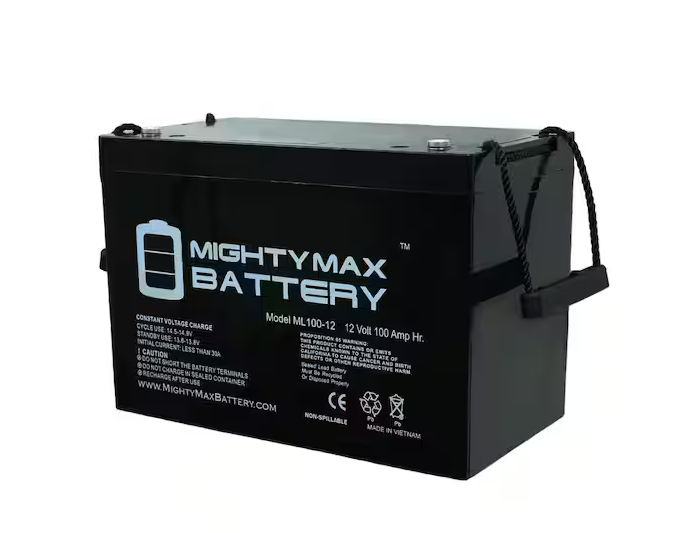
12V 100Ah SLA Replacement Battery for Leoch LPC12-100
- Delivering power when you need it, the MIGHTY MAX ML100-12 12-Volt 100 Ah uses a state of the art, heavy-duty, calcium-alloy grid that provides exceptional performance and service life in both float and cyclic applications. The ML100-12 is an Absorbent Glass Mat (AGM) technology with a valve regulated design, that can be used in enclosed and indoor environments without leaking or maintenance, providing a superior performance for thousands of models. MIGHTY MAX SLA batteries are utilized in a wide variety of applications including, Consumer Electronics, Electric Vehicles, Engine Starters, Golf Carts, Hunting, Lawn and Garden Tools, Medical Mobility, Motorcycles, Power sports, Portable Tools, Solar, Toys and Hobby, Access Control Devices, Emergency Lighting, Security and more.
- Highlights
- ML100-12 SLA is a 12-Volt 100 Ah group 30H Sealed Lead Acid (SLA) rechargeable maintenance free battery
- SLA/AGM spill proof battery has a characteristic of high discharge rate, wide operating temperatures, long service life and deep discharge recover
- Rechargeable battery that can be mounted in any position, resists shocks and vibration, long-lasting high performance in high and low temperatures
- Dimensions: 12.17 in. x 6.61 in. x 8.30 in. listing is for the battery and screws only, no wire harness or mounting accessories included
$179.99
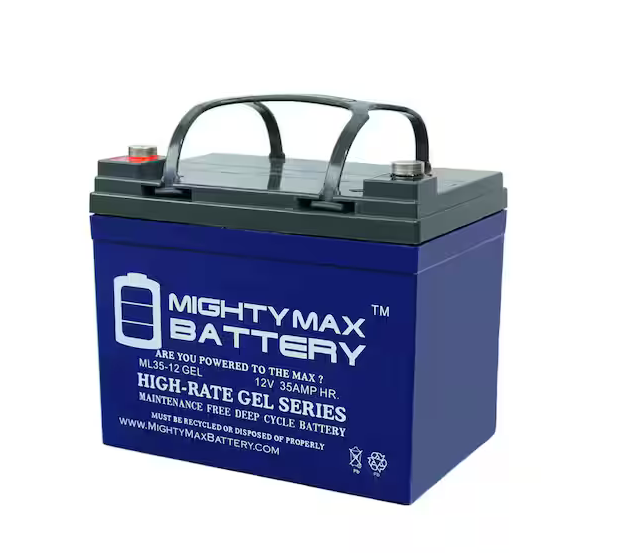
12V 35AH GEL Battery for GENERAC OD4575
- Delivering power when you need it, the Mighty Max ML35-12GEL 12-Volt 35 Ah (Maintenance Free) battery. Requires no addition of water during the life of the battery. The Mighty Max ML35-12 GEL is a TRUE DEEP CYCLE battery that can be mounted in any position, requires no maintenance. When a Gel Cell battery is charged, no hazardous fumes escape the battery case, gases are processed within the battery itself. Mighty Max GEL batteries are utilized in a wide variety of applications including; Consumer Electronics, Electric Vehicles, Engine Starters, Golf Carts, Hunting, Lawn and Garden Tools, Medical Mobility, Motorcycles, Power sports, Portable Tools, Solar, Toys and Hobby, Access Control Devices, Emergency Lighting, Security and more.
- Highlights
- ML35-12GEL is a 12-Volt 35 Ah GEL rechargeable maintenance free battery
- Reliable Performance: Our GEL batteries deliver consistent, long-lasting power thanks to their slower self-discharge rate compared to AGM batteries. This means they retain their charge longer when not in use, making them a superior upgrade choice.
- Durability in Extreme Conditions: Mighty Max GEL batteries provide consistent performance in extreme temperatures, excelling in a wide range of climates. Their resilience to temperature fluctuations allows for solid power delivery, whether you’re operating in the heat of summer or the chill of winter.
- Engineered for Rugged Use with Enhanced Safety Features: Our GEL batteries feature a thick, non-spillable gel paste that is safer and less prone to leaks, reducing the risk of acid spills and harmful fumes. This meticulous design enables our gel batteries to resist vibrations and shocks, making them well-suited for demanding environments.
- Trusted by our customers: Mighty Max has earned a solid reputation for quality and reliability, making it a brand people trust. Experience the benefits of advanced GEL technology for superior discharge capabilities, enhanced safety, better performance, and longer lifespan
$84.99
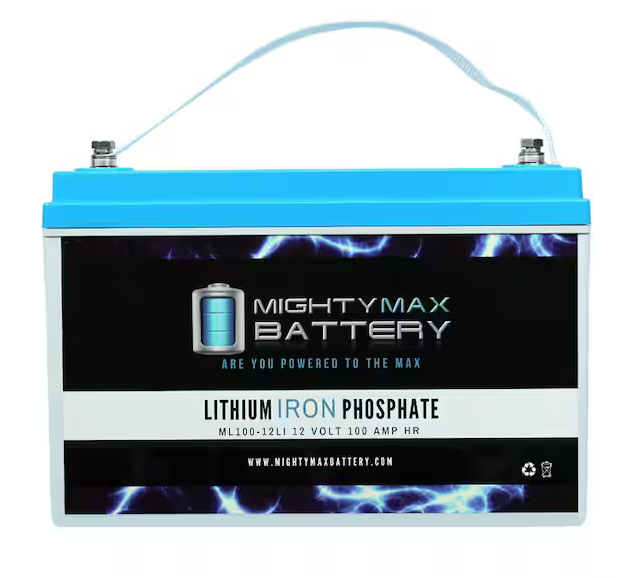
ML100-12LI – 12-Volt 100 AH Deep Cycle Lithium Battery
- Invest in power with the Mighty Max 12-Volt 100Ah Lithium Iron Phosphate Battery. The ML100-12LI will take your deep cycle battery experience to a whole new horizon. Manufactured with the highest quality components and the customers safety in mind, this battery contains a battery management system (BMS). BMS provides all kinds of protection for the battery and customer, equipped with Over charge and short circuit protection. Weighing only 30 lbs. and being a direct drop in replacement for its sister sealed lead acid and Gel batteries which weigh a hefty 60 lbs. Lighter, stronger and longer life span with 2500 cycles makes this the ideal battery for all your deep Cycle applications such as, Solar / wind energy systems, Off Grid systems, RV, Camping, Backup power systems and much more.
- Highlights
- ML100-12LI is a 12V 100Ah group 30H Lithium iron phosphate sealed, rechargeable and maintenance free battery, direct drop in lead acid replacement
- Battery ships minimally charged, to ensure optimal performance we kindly ask you to charge the battery to full capacity before using it for the first time
- Compatible with: Apollo Swing Gate Opener, Pride Mobility Pursuit XL Scooter, Ritar RA12-100, RA 12-100
- Designed for safety with built-in battery protection BMS, BMS provides high voltage protection, low voltage protection, over high current protection, high temperature protection, short circuit protection, and over charge protection, designed to be used in parallel with a maximum of 4 identical batteries, do not connect in series, make sure to only use a compatible lithium charger for this battery, having loose terminals will cause a buildup of heat resulting in damage to the battery
- Dimensions 12.99 in. x 6.77 in. x 8.66 in., listing is for the battery and screws only, no wire harness or mounting accessories included
$305.87
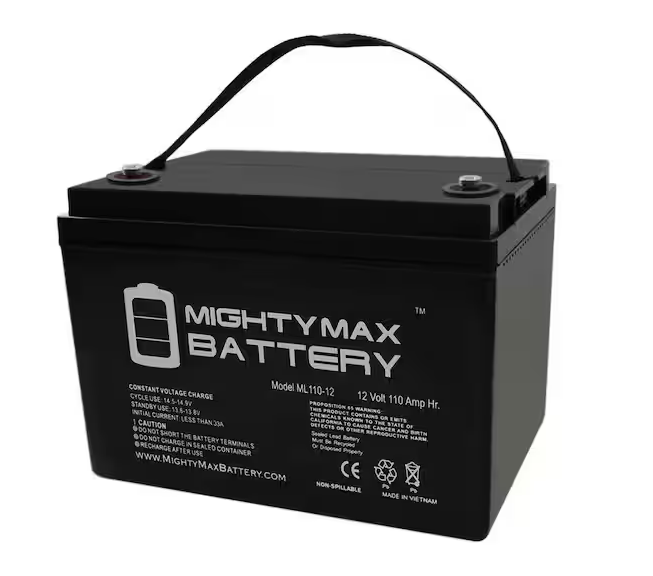
12V 110AH SLA Replacement Battery for Centennial CB12-115
- Delivering power when you need it, the Mighty Max ML110-12 Internal Thread 12-Volt 110 Ah uses a state of the art, heavy-duty, calcium-alloy grid that provides exceptional performance and service life in both float and cyclic applications. The ML110-12 Internal Thread is an Absorbent Glass Mat (AGM) technology with a valve regulated design, that can be used in enclosed and indoor environments without leaking or maintenance, providing a superior performance for thousands of models. Mighty Max SLA batteries are utilized in a wide variety of applications including; Consumer Electronics, Electric Vehicles, Engine Starters, Golf Carts, Hunting, Lawn and Garden Tools, Medical Mobility, Motorcycles, Power sports, Portable Tools, Solar, Toys and Hobby, Access Control Devices, Emergency Lighting, Security and more.
- Highlights
- ML110-12 Internal Thread is a 12-Volt 110 Ah Sealed Lead Acid (SLA) rechargeable maintenance free battery
- SLA/AGM spill proof battery has a characteristic of high discharge rate, wide operating temperatures, long service life and deep discharge recover
- Rechargeable battery that can be mounted in any position, resists shocks and vibration, long-lasting high performance in high and low temperatures
- Listing is for the battery and screws only, no wire harness or mounting accessories included
$199.99
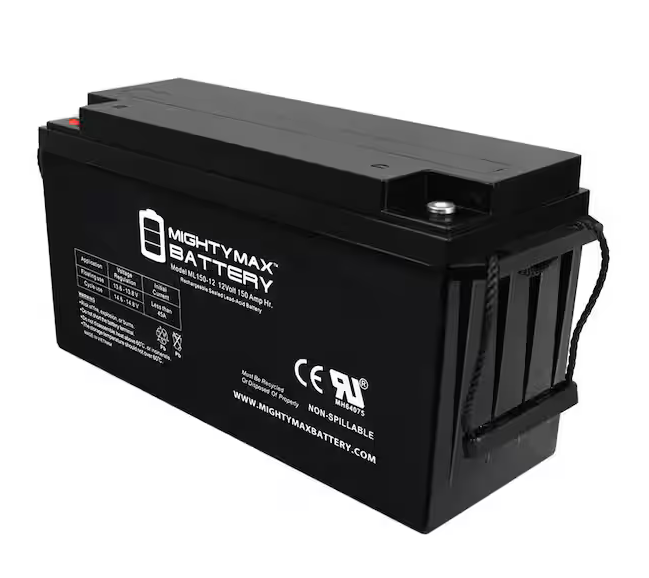
12-Volt 150AH SLA Replacement Battery for Trojan T-1275
- Delivering power when you need it, the Mighty Max ML150-12 12-Volt 150 Ah uses a state of the art, heavy-duty, calcium-alloy grid that provides exceptional performance and service life in both float and cyclic applications. The ML150-12 is an Absorbent Glass Mat (AGM) technology with a valve regulated design, that can be used in enclosed and indoor environments without leaking or maintenance, providing a superior performance for thousands of models. Mighty Max SLA batteries are utilized in a wide variety of applications including; Consumer Electronics, Electric Vehicles, Engine Starters, Golf Carts, Hunting, Lawn and Garden Tools, Medical Mobility, Motorcycles, Power sports, Portable Tools, Solar, Toys and Hobby, Access Control Devices, Emergency Lighting, Security and more.
- Highlights
- ML150-12 SLA is a 12-Volt 150 Ah Sealed Lead Acid (SLA) rechargeable maintenance free battery
- SLA/AGM spill proof battery has a characteristic of high discharge rate, wide operating temperatures, long service life and deep discharge recover
- Rechargeable battery that can be mounted in any position, resists shocks and vibration, long-lasting high performance in high and low temperatures
- Listing is for the battery and screws only, no wire harness or mounting accessories included, carrying handle attached to battery
$299.99
From Dead Batteries to Power Confidence: My Journey Through the World of Generator Energy Storage
I’ll never forget the sound of absolute silence when I desperately needed power. It was 2 a.m. during a brutal winter storm, my family huddled in blankets, and I confidently strode to my backup generator expecting salvation. I pulled the cord once. Twice. Nothing. The generator battery was completely dead, and I realized with crushing embarrassment that I knew absolutely nothing about the heart that powered my supposed emergency lifeline.
That humbling experience launched me into a deep dive through the world of generator batteries that transformed me from a clueless owner into someone who actually understands what keeps these machines ready when we need them most. Today, I’m sharing everything I’ve learned through countless hours of research, conversations with technicians, and yes, several more mistakes along the way.
What Are Generator Batteries, and How Do They Work?
Let me start with what I wish someone had explained to me from the beginning. Generator batteries aren’t actually powering your home during an outage—they’re the spark that brings your generator to life. Think of them as the ignition system, similar to how your car battery starts your engine but doesn’t power your drive down the highway.
Here’s how the magic actually happens: When you hit that start button or pull the cord on an electric-start generator, the battery for a generator delivers a surge of electrical current to the starter motor. This motor cranks the engine, which begins the combustion process. Once the engine fires up and reaches operating speed, the generator’s alternator takes over, producing the AC power you need while simultaneously recharging the battery for the next start.
What fascinated me most during my research was discovering that most generator batteries operate on a 12-volt system, just like automotive batteries. They’re lead-acid batteries, meaning they contain lead plates submerged in an electrolyte solution of sulfuric acid and water. When you draw power from the battery, a chemical reaction occurs between the lead plates and the electrolyte, releasing electrons that create electrical current. When you recharge it, this chemical reaction reverses.
The real revelation came when I learned that generator batteries don’t need massive capacity like the deep-cycle batteries that power RVs or boats for hours. They need what’s called “cranking power”—the ability to deliver a huge burst of current for just a few seconds. This is measured in Cold Cranking Amps (CCA), and it completely changed how I evaluated batteries.
What Is the Best Battery for a Generator?
After testing several options and talking to technicians who service generators professionally, I’ve concluded there’s no universal “best” battery—but there are definitely best practices for choosing one. The best battery for a generator depends on your specific generator model, your climate, and how you use your machine.
For most homeowners with standard backup generators, I’ve found that AGM (Absorbent Glass Mat) batteries offer the sweet spot of performance, durability, and maintenance requirements. Unlike traditional flooded lead-acid batteries, AGM batteries seal the electrolyte in fiberglass mats, making them spill-proof and virtually maintenance-free. I switched to an AGM battery after my second flooded battery incident (don’t ask), and I haven’t looked back.
The premium option that I’m eyeing for my next upgrade is lithium-ion technology. Yes, lithium-ion batteries for generators exist, and they’re genuinely impressive. They weigh about 70% less than lead-acid alternatives, can handle more charge cycles, and perform better in extreme temperatures. The only catch? They cost three to four times more than traditional batteries. For my critical backup system, I’m starting to think that investment might be worth it.
What I’ve learned to look for when selecting the best battery for my generator includes matching the CCA rating to my generator’s requirements (usually listed in the owner’s manual), choosing a battery with a proven warranty from a reputable manufacturer, and considering the physical dimensions to ensure it fits in the battery compartment. I once bought a battery with perfect specs but had to return it because it was literally half an inch too tall to fit in my generator’s housing.
How Long Do Generator Batteries Last?
This question haunted me after my initial failure, and the answer is maddeningly variable. In my experience, generator batteries typically last between three to five years, but I’ve seen this range swing wildly based on how they’re treated and where they live.
My first battery barely made it two years because I committed every mistake in the book: I stored my generator in an unheated garage through brutal winters, I rarely checked the battery’s condition, and I didn’t understand that generator batteries slowly self-discharge even when not in use. My current battery is entering its fourth year and still tests at near-full capacity because I finally learned how to care for it properly.
Temperature is the silent killer of battery longevity. For every 15 degrees Fahrenheit above 77°F, battery life decreases by about 50%. My generator sits in a southern-exposure garage that gets scorching hot in summer, which initially destroyed my batteries. I’ve since installed better ventilation and even painted the generator housing white to reflect heat. These simple changes dramatically extended my battery life.
The way you use your generator matters enormously too. If you only start your generator during actual emergencies, your battery for generators will likely die prematurely from neglect. I now run my generator under load for at least 30 minutes every month, which keeps everything lubricated, burns off moisture, and most importantly, fully recharges the battery. This regular exercise routine has been transformative.
How to Choose the Right Battery for My Generator
Choosing the right battery for my generator used to feel like navigating a foreign language, but I’ve developed a systematic approach that takes the guesswork out of the equation. Here’s the exact process I follow now, and it hasn’t steered me wrong yet.
First, I always consult my generator’s manual to find the manufacturer’s specifications. This tells me the required voltage (almost always 12V for residential generators), the minimum CCA rating needed for reliable starting, and the physical dimensions of the battery compartment. I learned this lesson expensively when I bought an amazing battery that simply wouldn’t fit.
Second, I assess my climate and storage conditions honestly. I live in an area with genuine winters, so I now prioritize batteries with high CCA ratings. The best battery for a generator in Minnesota is different from what works in Florida. Cold weather dramatically reduces battery performance—a battery rated at 600 CCA might only deliver 300 CCA at zero degrees Fahrenheit.
Third, I consider the battery type based on my willingness to perform maintenance. Traditional flooded batteries are cheapest but require checking water levels and cleaning terminals. AGM batteries cost 30-50% more but eliminate maintenance hassles. For my backup generator that I depend on during emergencies, I’ve decided the extra cost of AGM is worth the peace of mind.
Fourth, I evaluate the warranty and brand reputation. I used to buy the cheapest battery available, replacing it every two years. Now I invest in quality brands offering three to five-year warranties. Over time, this approach actually costs less and provides better reliability. Brands like Interstate, Optima, DieHard, and Duracell have proven reliable in my experience and come recommended by the technicians I’ve befriended.
Finally, I calculate the true cost including lifespan and maintenance. A $60 flooded battery that lasts two years costs $30 per year. A $120 AGM battery that lasts five years costs $24 per year. The math started making sense once I looked beyond the sticker price.
Can I Use Any Battery for My Generator?
This question almost got me into serious trouble once, and I want to save you from the same mistake. Technically, yes, you can use various batteries in your generator, but practically speaking, no, you absolutely shouldn’t just grab any 12-volt battery and call it good.
I once tried using a marine deep-cycle battery in my generator because it was what I had available. It worked initially, but I quickly noticed sluggish starting, especially in cold weather. Deep-cycle batteries are designed to discharge slowly over long periods, while generator batteries need to deliver massive cranking power instantly. They’re fundamentally designed for different purposes.
Car batteries seem like an obvious substitute, and they’ll work in a pinch, but they’re optimized for vehicles that recharge constantly while driving. Generators that sit idle for weeks or months need batteries that better resist self-discharge. I’ve experimented with automotive batteries in my smaller portable generator, and they work acceptably, but they don’t last as long as proper generator batteries.
The voltage must match exactly—never try to use a 6-volt or 24-volt battery in a 12-volt system. Beyond that, the physical terminal configuration matters more than I initially realized. Some batteries have top-mount terminals, others have side terminals, and the cable connections on your generator are designed for one or the other. I once bought a battery with the wrong terminal type and spent an entire afternoon rigging adapters when I should have just bought the right battery.
The CCA rating is where you absolutely cannot compromise. If your generator requires 350 CCA and you install a battery rated for 250 CCA, you might get lucky on warm days, but when you desperately need power during a winter storm, that underpowered battery will leave you literally in the dark. I always match or exceed the manufacturer’s CCA specification now—it’s not an area to cut corners.
How to Charge a Generator Battery
Learning how to charge a generator battery properly was a turning point in my relationship with my backup power system. I used to think the generator automatically maintained its battery, and technically it does—but only when running. What I didn’t understand was that batteries self-discharge constantly, and a generator sitting unused for months will have a dead battery when you need it most.
My current routine involves multiple charging strategies. During the summer months when I run my generator monthly for exercise, the built-in charging system handles everything. The generator’s alternator produces around 14 volts while running, which recharges the battery and maintains it at full capacity. I make sure to run the generator under at least 50% load for at least 30 minutes to ensure full recharging.
During winter or when I know the generator won’t run for extended periods, I’ve invested in a quality battery maintainer. This isn’t the same as a regular battery charger—it’s a smart device that monitors the battery and provides exactly the right amount of current to keep it at peak charge without overcharging. I plug mine in whenever the generator isn’t in use, and it automatically cycles on and off as needed. This single investment has probably doubled my battery lifespan.
For emergency charging when the battery is significantly depleted, I use a standard battery charger set to a low amp rate. I’ve learned through experience that slow charging (2-6 amps) is far better for battery health than rapid charging. A generator battery charged slowly at 4 amps will last longer than one repeatedly hammered with 40-amp fast charges. I usually charge overnight, which gives plenty of time for a complete, gentle charge cycle.
One critical lesson I learned the hard way: always disconnect the battery from the generator before charging with an external charger, especially with older generators. The charging voltage can damage sensitive electronic components in the generator’s control system. I destroyed a voltage regulator once by charging the battery while connected—a $200 lesson I won’t repeat.
What Is the Difference Between a Generator Battery and a Car Battery?
This question consumed me for weeks because the batteries look so similar that I convinced myself they were interchangeable. They’re both 12-volt lead-acid batteries, they have similar physical sizes, and they perform the same basic function of starting an engine. But after digging deep into the engineering, I discovered the differences matter more than the similarities.
The fundamental distinction lies in the discharge and recharge cycles. Car batteries live in vehicles where the alternator constantly recharges them during operation. They’re designed for frequent, small discharge cycles—just enough to crank the engine, then immediate recharging. They’re optimized for high cranking power but relatively shallow discharge capacity.
Generator batteries, on the other hand, must sit dormant for extended periods while slowly self-discharging, then deliver reliable starting power on demand. They need lower self-discharge rates and better resistance to sulfation (the buildup of lead sulfate crystals that kills inactive batteries). Quality generator batteries use slightly different plate compositions and electrolyte formulations to handle these unique demands.
The construction details differ in subtle but important ways. Generator batteries often have heavier-duty plates that resist vibration better since generators can shake quite a bit during operation. The case design sometimes includes better insulation and sealing because generators often live in outdoor locations exposed to temperature extremes and moisture.
I’ve run car batteries in my generator successfully, and they work fine if you maintain them carefully. But side-by-side, my dedicated generator battery has outlasted two car batteries in the same application. The specialized design makes a measurable difference in longevity and reliability when you actually need the generator to start.
The warranty terms also reveal the differences—most car batteries come with warranties based on months of use, while generator batteries are often rated for longer periods because manufacturers expect different usage patterns. This isn’t just marketing; it reflects genuine engineering differences optimized for different applications.
Are There Solar-Powered Batteries for Generators?
When I first encountered solar-powered batteries for generators, I thought I’d discovered some revolutionary hybrid technology. The reality is more nuanced and actually more interesting than I initially imagined. Let me clear up the confusion that tangled me up for weeks.
There aren’t really “solar-powered batteries” as such—batteries are batteries, storing chemical energy regardless of how they’re charged. What exists is solar charging systems for generator batteries, and I’ve now implemented one that’s genuinely transformed my backup power strategy.
I installed a small 20-watt solar panel connected to a charge controller that maintains my generator battery year-round. The setup cost me about $80 and has eliminated my concerns about battery self-discharge during long idle periods. The solar panel produces enough current to offset the natural self-discharge rate, keeping my generator battery at full charge even during months when I don’t run the generator.
The charge controller is the critical component I initially tried to skip (mistake!). It regulates the voltage and current from the solar panel, preventing overcharging while maximizing charging efficiency. Without it, I risked damaging my battery with excessive voltage on bright summer days.
For portable generators that you might take camping or use in remote locations, solar charging makes even more sense. I’ve seen setups where people use folding solar panels to maintain their portable generator batteries between uses, ensuring reliable starting even when there’s no electrical outlet for days. The combination of solar charging and generator backup creates a remarkably resilient power system.
What really excites me about solar battery charging is the potential for whole-home backup systems that combine solar panels, battery storage, and generator backup. These integrated systems use solar to charge large battery banks that power your home, with the generator only kicking in during extended cloudy periods or high-demand situations. It’s a more expensive setup, but the reliability and fuel savings are compelling.
How to Maintain a Generator Battery
Battery maintenance transformed from a mysterious chore into a simple routine once I understood what actually matters. Proper generator battery maintenance has extended my battery life by years and eliminated those panic moments when I need emergency power.
My monthly maintenance ritual takes about 15 minutes and starts with a visual inspection. I check the battery case for cracks, bulging, or leaking—any of these signals immediate replacement. I inspect the terminals for corrosion, that white or blue-green crusty buildup that impedes electrical connection. When I find corrosion, I disconnect the battery (negative terminal first!), clean the terminals with a wire brush and a baking soda-water solution, rinse with clean water, dry thoroughly, and apply a thin coat of petroleum jelly or terminal protector spray before reconnecting.
For flooded lead-acid batteries, I check the electrolyte levels monthly. The plates must stay submerged in electrolyte, or they’ll be damaged permanently. I top off cells with distilled water only—never tap water, which contains minerals that damage the battery. I learned this after ruining a battery by adding tap water when I ran out of distilled.
I test the battery voltage regularly with a simple multimeter, which costs about $15. A fully charged 12-volt battery should read between 12.6 and 12.8 volts when the generator hasn’t run for several hours. If it reads below 12.4 volts, I charge it immediately. Below 12.0 volts indicates a severely depleted battery that needs immediate attention.
Every three months, I perform a load test using either a professional load tester or by actually starting the generator and observing how it cranks. If the starter motor sounds sluggish or the voltage drops dramatically during cranking, the battery is declining even if resting voltage seems acceptable. This test reveals battery health more accurately than voltage measurements alone.
Temperature management became a priority after I realized heat destroys batteries faster than anything else. I keep my generator battery as cool as possible, ensuring proper ventilation around the generator and avoiding direct sunlight on the battery compartment. In extreme heat, I’ve even placed a small fan near the generator to improve air circulation.
I run my generator under load monthly for at least 30 minutes, which fully recharges the battery and prevents the sulfation that kills inactive batteries. This exercise routine maintains both the generator and the battery in ready condition.
What Are the Signs That My Generator Battery Needs Replacement?
Recognizing when my generator battery needs replacement used to baffle me until I learned to read the warning signs. Now I can predict battery failure weeks or months before it happens, avoiding those desperate midnight moments when I discover a dead battery during an emergency.
The most obvious sign is sluggish starting. When I press the start button and hear the starter motor cranking slower than normal—that laboring, grinding sound instead of the confident whir of a healthy start—my battery is telling me it’s declining. This often appears gradually, so I compare each monthly test run to the previous month’s performance.
Difficulty holding a charge is a red flag I watch for obsessively now. If I fully charge my battery but it drops below 12.4 volts within a week or two without use, the battery has developed internal problems. This accelerating self-discharge indicates sulfation or plate damage that won’t improve.
Physical changes to the battery case demand immediate attention. Bulging or swelling indicates internal pressure from excessive heat or overcharging. Cracks or leaks mean the battery is finished—I replace it immediately regardless of age. I once tried to limp along with a slightly leaking battery, and the sulfuric acid damaged the generator’s mounting platform. That repair cost far more than a new battery.
Corrosion that constantly returns despite regular cleaning often signals that the battery is venting excessive gases due to internal breakdown. Some corrosion is normal, but if I clean the terminals and they’re crusty again within days, the battery is failing.
Voltage irregularities tell their own story. If my fully charged battery reads above 13.0 volts at rest, it’s being overcharged due to internal problems. If it can’t reach 12.6 volts even after a full charge cycle, it has lost capacity and needs replacement.
Age alone is a replacement indicator. Regardless of how healthy a battery seems, I replace any generator battery that’s reached five years old. The risk of catastrophic failure during an emergency isn’t worth the modest savings of squeezing an extra year from an aging battery.
How Much Do Generator Batteries Cost?
Understanding generator battery costs helped me budget appropriately and make informed decisions about when to invest in premium options versus economical choices. The price spectrum is wider than I initially expected, ranging from under $50 to over $300 for essentially the same voltage and size.
Entry-level flooded lead-acid batteries from discount retailers start around $40-60 for basic models with 300-400 CCA ratings. I’ve used these in my portable generator with acceptable results, though they typically need replacement every two to three years. For emergency backup where I test monthly but rarely run the generator seriously, these budget options make economic sense.
Mid-range flooded batteries from quality manufacturers like Interstate or DieHard run $70-120 and offer better construction, higher CCA ratings, and three to four-year warranties. This is the price range where I’ve found the best value for my primary backup generator—good enough reliability without premium pricing.
AGM batteries occupy the $100-200 price range, and this is where I’ve settled for my critical backup systems. The maintenance-free operation and superior performance in temperature extremes justify the higher cost. My current AGM battery cost $145 three years ago and shows no signs of decline.
Premium AGM batteries with enhanced features or very high CCA ratings can reach $200-250. I’ve considered these for my larger generator that powers my entire home, where reliability during extended outages is absolutely critical. The incremental cost over mid-range AGM batteries is harder to justify unless you have specific performance requirements.
Lithium-ion batteries for generators represent the premium tier at $250-400 or more. I haven’t yet pulled the trigger on lithium technology because the price premium is substantial, though the weight savings, longer lifespan, and superior performance are tempting. If I lived in an area with extreme temperatures or frequent power outages, I’d seriously consider the investment.
Hidden costs factor into the true expense equation. Shipping for batteries adds $10-30 to online purchases due to hazardous material fees. Core charges (deposits on the old battery) run $10-20 if you can’t return your old battery for recycling. Installation costs matter if you’re not comfortable doing it yourself, though most people can easily replace a generator battery.
Warranty value shouldn’t be overlooked when comparing costs. A $60 battery with a one-year warranty costs the same over four years as a $120 battery with a four-year warranty, but the latter provides better reliability and less hassle.
Where Can I Buy Generator Batteries
Finding quality generator batteries used to involve driving to multiple stores, comparing limited options, and settling for whatever was in stock. I’ve since discovered better approaches that save time and often money while ensuring I get exactly the right battery.
Home improvement stores like Home Depot and Lowe’s became my go-to starting point. They stock a decent range of batteries for generators, and I can physically inspect the battery before buying. The return policies are generous if I discover fitment issues, and prices are competitive on major brands. The associates rarely know much about generator batteries specifically, so I come armed with my generator’s specifications.
Automotive parts stores like AutoZone, O’Reilly’s, and Advance Auto Parts offer broader selections and more knowledgeable staff, though their generator-specific inventory varies by location. I’ve found the best service at stores in rural or suburban areas where generators are common. They often stock batteries compatible with popular generator models and can order specific batteries within a day or two.
Farm supply stores surprised me with excellent generator battery selections. Tractor Supply and local farm co-ops cater to customers who depend on generators for critical applications, so they stock quality batteries and often know their products well. Prices tend to be slightly lower than home improvement stores, and the staff frequently use generators themselves.
Online retailers offer the widest selection and often the best prices, though shipping costs can eliminate savings. I’ve successfully purchased generator batteries from Amazon, Battery Mart, and manufacturer websites. The key is carefully verifying specifications and checking shipping costs before ordering. I also verify the manufacture date when possible—batteries lose capacity sitting in warehouses, and I want the freshest battery available.
Generator dealers and service centers carry batteries specifically designed for their brands, though prices are typically higher than general retailers. For warranty work or if I need absolute certainty about compatibility, I use authorized dealers. They can also install the battery and test the generator’s charging system.
Local independent battery specialists have become my secret weapon for finding unusual or high-performance batteries. These shops specialize in batteries for everything from generators to golf carts to industrial equipment. The expertise is exceptional, prices are competitive, and they often stock specialty batteries not available in chain stores.
I always call ahead to verify inventory before driving to any store. Nothing wastes time like making a special trip only to discover they don’t stock the battery I need. I’ve learned to provide the generator’s make, model, and year along with the desired battery type, and most stores can confirm availability within minutes.
Can I Use a Deep-Cycle Battery for My Generator?
The question of using a deep-cycle battery for my generator emerged during my research phase, and the answer fascinates me because it reveals fundamental truths about battery engineering that I never understood before.
Technically, yes, you can use a deep-cycle battery in a generator—I’ve done it successfully. Practically, it’s almost always a suboptimal choice that creates more problems than it solves unless you have specific unusual requirements.
Deep-cycle batteries are engineered to discharge 50-80% of their capacity slowly over extended periods, then recharge fully. Think of them powering trolling motors on fishing boats for hours or running lights and appliances in RVs overnight. They have thicker plates and different internal construction that makes them excel at sustained discharge cycles.
Generator batteries, conversely, are designed for starting applications—delivering massive cranking current for just seconds, then immediately recharging. They use thinner plates optimized for surface area and chemical reaction speed rather than depth of discharge.
When I tried a deep-cycle battery in my generator out of curiosity, it worked, but starting performance was noticeably weaker, especially in cold weather. The CCA rating on my deep-cycle battery was lower than an equivalent-sized starting battery, and that translated to slower cranking and more stress on the starter motor.
The situation where deep-cycle batteries make sense for generators is dual-purpose applications. Some people run inverter generators that also charge battery banks for off-grid power systems. In these cases, a true dual-purpose battery or dedicated deep-cycle battery might be appropriate for the battery bank being charged, while the generator itself still needs a proper starting battery.
I’ve also encountered situations where people use generators in RVs or boats and want to minimize battery inventory by using one deep-cycle battery for both house power and generator starting. This compromise works if you select a high-quality dual-purpose battery with adequate CCA ratings, though it won’t perform either function as well as specialized batteries.
The cost argument for using deep-cycle batteries falls apart under scrutiny. Deep-cycle batteries typically cost more than starting batteries, and their advantages provide no benefit in a generator application. I’m essentially paying extra for capabilities I’ll never use while accepting reduced performance in the function I actually need.
What Is the Lifespan of a Generator Battery?
Understanding the lifespan of a generator battery required me to separate manufacturer claims from real-world experience, and what I learned reshaped my maintenance approach and replacement planning entirely.
In ideal conditions with perfect maintenance, generator batteries can last five to seven years. I’ve heard stories of batteries reaching eight or even ten years, but these are exceptional outliers involving meticulous care and favorable circumstances. More realistically, I plan for three to five years of service, and I’m delighted when a battery exceeds those expectations.
Temperature dramatically affects lifespan in ways I never imagined before researching this topic. For every 15°F above 77°F, battery life decreases by roughly 50%. My generator sits in a garage that reaches 95°F in summer, reducing expected battery life from five years to perhaps three years. Conversely, extreme cold doesn’t shorten lifespan but reduces capacity—a fully charged battery at 0°F has only half the capacity it would have at 80°F.
Usage patterns influence longevity more than the calendar. A battery that sits unused for months slowly sulfates and degrades faster than one that cycles regularly through discharge and recharge. My monthly generator exercise routine keeps the battery active and dramatically extends its life compared to sitting dormant until emergencies.
The quality of the generator’s charging system matters enormously. I had a generator with a faulty voltage regulator that slowly overcharged batteries, destroying them within 18 months. After repairing the charging system, batteries in the same generator now last their full expected lifespan. This taught me that battery life problems sometimes indicate generator problems rather than battery problems.
Maintenance vigilance directly correlates with lifespan in my experience. My first batteries died prematurely because I neglected them. My current batteries are thriving because I check them monthly, maintain proper charge levels, clean terminals, and address problems immediately.
The type of battery affects expected lifespan significantly. Budget flooded batteries typically give me two to three years. Quality flooded batteries reach three to four years. AGM batteries are hitting four to five years. The premium I pay for AGM batteries returns value through extended service life and reduced maintenance hassles.
I track my battery installation dates religiously now, marking each battery with the installation month and year using a permanent marker. This simple habit prevents me from losing track of battery age, which helps me proactively replace batteries before they fail during emergencies.
How to Install a New Battery in a Generator
Learning how to install a new battery in a generator transformed from an intimidating task into a simple 15-minute job once I understood the proper sequence and precautions. Let me walk through the exact process I follow now.
Before touching anything, I gather my tools: adjustable wrench or appropriate socket set, wire brush, baking soda and water solution, clean rag, petroleum jelly or terminal protector, and safety glasses. I also verify I have the correct replacement battery within arm’s reach.
Safety comes first—I never work on a generator that’s running or has been running recently. I let hot generators cool completely, ensure adequate ventilation (remember, batteries can emit hydrogen gas), and remove jewelry that could short circuit on the battery terminals.
The removal sequence is critical: I always disconnect the negative (black) cable first, then the positive (red) cable. This prevents accidental short circuits if my wrench touches the frame while removing the positive terminal. I learned this rule after creating an impressive shower of sparks that taught me an expensive lesson.
With cables disconnected, I remove the battery hold-down clamp or bracket. Different generators use different securing systems—some have a simple strap, others use threaded rods with nuts, and some have complex mounting brackets. I keep track of all hardware because I’ll need it for installation.
I lift the old battery carefully—batteries are heavy and awkward, and I’ve nearly dropped them more times than I’d like to admit. I set it aside in a safe location away from children and pets, planning to recycle it at an auto parts store for the core deposit refund.
Before installing the new battery, I clean the battery tray thoroughly, removing any corrosion or debris. I also clean the cable terminals using the wire brush and baking soda solution, ensuring bright, clean metal for optimal electrical connection.
I position the new battery for my generator in the tray, ensuring proper orientation with positive and negative terminals matching the cable locations. Some batteries can only fit one way, but others have enough play to install backward—a mistake that can damage the generator’s electrical system.
Installation reverses the removal sequence: I connect the positive (red) cable first, then the negative (black) cable. I tighten terminals firmly but not excessively—overtightening can crack the battery case or strip threads. I apply a thin coat of petroleum jelly to terminals after connection to prevent corrosion.
I reinstall the hold-down system, ensuring the battery is secure but the clamp isn’t crushing the case. I’ve cracked battery cases by overtightening hold-down straps, creating leaks that destroyed the battery.
The final step is testing—I start the generator and verify proper operation. I check voltage at the battery with a multimeter while the generator runs, confirming the charging system is working (should read 13.8-14.4 volts during operation).
Why Won’t My Generator Start Even with a New Battery?
This nightmare scenario haunted me after I once installed a brand-new battery only to discover my generator still wouldn’t start. The frustration was overwhelming, but the troubleshooting process taught me that generator batteries are just one component in a starting system with multiple potential failure points.
The first time this happened, I had simply installed a battery with insufficient CCA rating. My generator required 350 CCA minimum, and I’d purchased a battery rated at 280 CCA because it was cheaper. Even though it was brand new, it couldn’t deliver enough cranking power. I returned it and bought the properly rated battery, solving the problem immediately.
Connection issues cause more starting failures than I ever imagined before diagnosing these problems. Corroded, loose, or damaged cables prevent current from reaching the starter motor even with a perfect battery. I now clean all connections thoroughly during battery replacement and check that terminals are tight.
The safety systems on modern generators can prevent starting even with good batteries. Low oil shutoff switches, closed fuel valves, clogged fuel filters, faulty ignition switches, and engine kill switches all interrupt the starting circuit. I learned to methodically check each safety interlock before assuming electrical problems.
Starter motor failure mimics battery problems convincingly. I once spent hours troubleshooting connections and trying different batteries before discovering my starter motor had failed internally. The battery was delivering current, but the starter couldn’t convert that current into mechanical cranking motion. A simple tap on the starter housing with a hammer temporarily freed it, confirming the diagnosis.
Dead or corroded fuses can stop the starting circuit despite a perfect battery. Many generators have fuses protecting various circuits, and I now check these routinely during troubleshooting. A $2 fuse once cost me hours of frustration before I thought to check it.
Incorrect installation, though embarrassing to admit, happens more often than you’d think. I once reversed the battery terminals accidentally, which prevented starting and could have damaged sensitive electronics. Always double-check terminal polarity before considering more complex problems.
The charging system itself can prevent starting if it’s malfunctioning. A failed voltage regulator or diode can drain the battery even while installed in the generator. I’ve encountered generators that kill new batteries within hours because of charging system problems that needed professional repair.
Mechanical problems in the engine can prevent starting regardless of battery condition. Seized engines, broken recoil starters, or internal damage won’t respond to even perfect electrical systems. If the engine won’t turn over manually, electrical problems aren’t your issue.
Are There Rechargeable Batteries for Portable Generators?
When I first explored rechargeable batteries for portable generators, I was confused about what this actually meant since all generator batteries are technically rechargeable. After deeper research, I realized people asking this question usually want to understand power options for portable generators beyond traditional lead-acid batteries.
Yes, modern portable generators increasingly use rechargeable lithium-ion or lithium iron phosphate (LiFePO4) batteries as their starting batteries, and these represent a genuine advance in technology. I’ve tested several portable generators with lithium starting batteries, and they offer impressive advantages.
The weight savings alone transforms portable generator portability. My traditional portable generator with a lead-acid battery weighs 85 pounds total. A comparable lithium-equipped generator weighs 60 pounds—a massive difference when you’re carrying it up basement stairs or loading it into a truck bed.
Lithium batteries maintain voltage better throughout the discharge cycle, providing more consistent starting power even when partially discharged. My lead-acid portable generator becomes hard to start when the battery drops below 60% charge. The lithium version starts reliably down to 20% charge or lower.
The real revolution in portable generator power comes from completely battery-powered portable power stations that eliminate gas engines entirely. These devices—made by companies like Goal Zero, Jackery, and EcoFlow—use massive lithium battery banks rechargeable from solar panels, wall outlets, or even car charging ports. I’ve added one to my emergency preparedness kit, and it’s transformed how I think about backup power for small loads.
For traditional gas-powered portable generators, the starting battery is almost always a standard 12-volt lead-acid or AGM battery, exactly like larger generators use. These are absolutely rechargeable—they recharge from the generator’s charging system while running and can be recharged with external battery chargers when needed.
I now maintain my portable generator battery with a small 6-watt solar panel that keeps it topped off between uses. This simple addition means my portable generator is always ready for emergencies or outdoor activities without worrying about battery condition.
Some innovative portable generators combine gas engines with substantial battery storage, creating hybrid systems that can run on either fuel or battery power. These offer the extended runtime of gas with the convenience and quietness of battery operation. The technology excites me, though prices remain high for now.
What Are the Best Brands for Generator Batteries?
Identifying the best brands for generator batteries consumed weeks of my research time as I sorted through marketing claims, customer reviews, and real-world testing results. After using multiple brands across several generators, I’ve developed strong opinions based on actual performance.
Interstate Batteries tops my personal list for generator batteries based on consistent reliability and excellent warranty support. I’ve run Interstate batteries in two of my generators for a combined seven years without a single failure. Their deep-cycle and starting batteries both perform excellently, and the nationwide dealer network means I can find replacements easily.
Optima batteries represent premium performance, particularly their RedTop starting batteries. I installed an Optima RedTop in my critical backup generator three years ago, and it’s been absolutely flawless despite challenging storage conditions. The SpiralCell technology makes them incredibly resistant to vibration and temperature extremes. My only complaint is the price—they’re definitely expensive, but the performance justifies the cost for critical applications.
DieHard batteries from Advance Auto Parts have impressed me repeatedly. I run DieHard Platinum AGM batteries in my portable generators, and they’ve delivered exceptional value. The three-year replacement warranty provides confidence, and real-world performance matches or exceeds competitors costing 20% more.
Duracell batteries (manufactured by East Penn) surprised me with excellent performance at moderate prices. I initially dismissed them as a marketing brand trading on the flashlight battery name, but the automotive batteries are legitimate quality products. I’ve used them in my less critical applications with complete satisfaction.
ACDelco batteries offer solid performance for budget-conscious buyers. While they don’t match premium brands in longevity or extreme-condition performance, they provide acceptable reliability at attractive prices. For occasional-use portable generators or secondary backup systems, ACDelco batteries deliver good value.
Odyssey batteries from EnerSys represent the extreme premium category. These AGM batteries cost 50-100% more than standard options but deliver extraordinary performance in extreme conditions. I haven’t personally invested in Odyssey batteries yet, but professionals who depend on generators in harsh environments swear by them.
Universal Power Group (UPG) and Mighty Max batteries dominate budget online sales, offering very low prices for acceptable performance. I’ve experimented with these in non-critical applications, and they work fine if you accept reduced lifespan and basic specifications. They’re not what I trust for emergency backup, but they’re adequate for casual use.
Brands I avoid after negative experiences include no-name batteries from discount retailers (they’ve all failed prematurely for me), extremely cheap import batteries that can’t meet their labeled specifications, and any battery without a clear warranty from an identifiable manufacturer.
How Do I Store Generator Batteries When Not in Use?
Learning proper battery storage techniques dramatically extended my battery life and eliminated those frustrating dead-battery situations when I needed power urgently. The difference between proper and improper storage is literally years of usable life.
For generator batteries remaining installed in the generator, my storage routine begins with fully charging the battery before the storage period. A fully charged battery resists freezing and sulfation far better than a partially charged one. I either run the generator under load until the battery fully recharges, or I use an external charger to bring it to peak charge.
I install a battery maintainer on any generator stored for more than a month. This device automatically monitors the battery and provides exactly enough charging current to offset self-discharge without overcharging. The $25 I spent on my maintainer has probably saved me hundreds in premature battery replacements.
Temperature management became a priority after I learned how heat destroys batteries. I store my generators in the coolest available location—my basement rather than my garage whenever possible. Batteries stored at 80°F lose capacity twice as fast as batteries stored at 60°F. Every degree matters.
For batteries removed from generators during extended storage, I clean the terminals thoroughly, fully charge them, and store them in a cool, dry location away from concrete floors. The old wives’ tale about concrete draining batteries is mostly myth with modern battery cases, but I store mine on wood shelves anyway out of abundance of caution.
I check stored batteries monthly even with maintainers attached. A quick voltage check with my multimeter takes 30 seconds and prevents surprises. If voltage drops below 12.4 volts, I recharge immediately to prevent sulfation damage.
Proper ventilation during storage prevents hydrogen gas accumulation. I never store batteries in completely sealed containers or poorly ventilated closets. The risk of explosive hydrogen buildup, while small, isn’t worth taking.
I protect battery terminals during storage to prevent accidental short circuits. I either install terminal covers or simply wrap terminals with electrical tape. A wrench accidentally dropped across exposed terminals can create a dangerous short circuit.
For long-term storage exceeding six months, I remove batteries from generators completely and store them on my battery maintainer. This prevents phantom loads from generator electronics from slowly draining the battery and ensures peak charge when I need the equipment again.
What Safety Tips Should I Follow When Handling Generator Batteries?
Learning proper safety procedures for handling generator batteries came after a few close calls that could have been serious injuries. These aren’t just theoretical warnings—batteries contain dangerous materials and can release explosive gases under certain conditions.
My primary safety rule is always wearing safety glasses when working with batteries. Sulfuric acid is incredibly corrosive and can cause permanent eye damage. I once got a tiny splash of battery acid on my regular glasses while cleaning terminals, and it etched the plastic lenses within seconds. Eye protection is non-negotiable.
I never work with batteries while wearing jewelry. My wedding ring could short circuit battery terminals, creating enough heat to cause severe burns or even weld the ring to my finger. I remove all jewelry before touching batteries now, without exception.
Adequate ventilation is essential whenever charging or working with batteries. Lead-acid batteries release hydrogen gas during charging—a highly explosive gas that can ignite from the smallest spark. I charge batteries in my garage with the door open or outdoors, never in enclosed spaces.
I always disconnect the negative terminal first when removing batteries and connect it last when installing. This prevents accidental short circuits if my tools touch the frame. The opposite sequence when installing—positive first, then negative—provides the same protection.
Proper lifting technique saves my back when handling heavy batteries. I squat with legs rather than bending at the waist, keep the battery close to my body, and get help with particularly heavy batteries rather than risking injury. A 50-pound battery is awkward to lift alone.
I never smoke or create sparks near batteries. The hydrogen gas they emit can ignite explosively from the smallest ignition source. I’ve seen videos of batteries exploding from improper jump-starting procedures, and the force is genuinely frightening.
Acid spill procedures are part of my safety kit now. I keep baking soda, water, and absorbent materials near my battery work area. If I spill battery acid, I neutralize it immediately with baking soda solution rather than trying to wipe it up with water alone.
I dispose of dead batteries properly at recycling centers rather than throwing them in trash. Lead-acid batteries contain toxic lead and corrosive acid that absolutely cannot go into landfills. Most auto parts stores accept old batteries for recycling and often provide core charge refunds.
Protective clothing makes sense when working extensively with batteries. I wear old clothing and gloves when cleaning corroded terminals or checking electrolyte levels because sulfuric acid ruins fabric immediately. Dedicated work clothes stay in my garage for these tasks.
Looking back on my journey from complete ignorance to confident competence with generator batteries, I’m struck by how much these relatively simple devices matter to our backup power reliability. That terrifying night when my family needed power and my generator failed taught me lessons I’ll never forget.
The knowledge I’ve gained through research, mistakes, and careful maintenance has transformed my generators from mysterious machines into understood tools I trust completely. My batteries now last years longer, my generators start reliably every time, and I sleep better knowing my backup power system is genuinely ready for emergencies.
Whether you’re just buying your first generator or you’ve been relying on one for years, understanding your generator battery unlocks better performance, longer life, and real peace of mind. The hour you invest learning these principles will pay dividends for years through reliable power when you need it most.
I still run my generators monthly, still check my batteries regularly, and still keep my maintainers attached during idle periods. These simple habits that once seemed like unnecessary work now feel like basic care for equipment I depend on. And that generator that failed me during the winter storm? It’s been flawless for five years now, ready whenever we need it, because I finally understand the heart that brings it to life.