



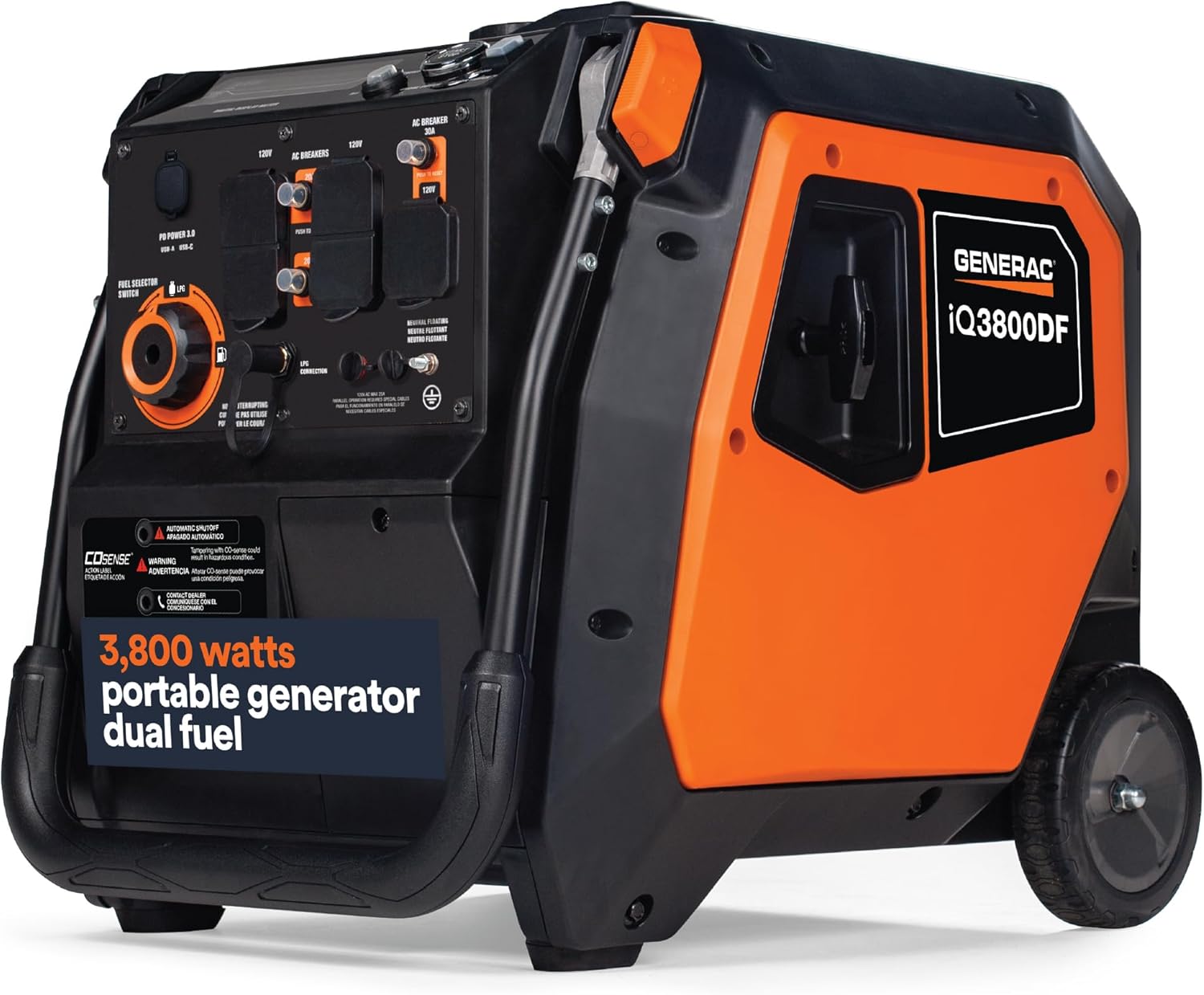
Generac 3,800-Watt Dual-Fuel Portable Inverter Generator – Gas and Propane Compatible – Quiet Operation – Clean, Stable Power – Great for Home Backup, Camping, and RV Use
- Portable Power Solution: The iQ3800 8946 inverter generator is your go-to portable power source for outdoor adventures, from camping trips to tailgating events, ensuring stable power without disturbing your surroundings
- Convenient Electric Start: Say goodbye to manual cranking. The electric start feature, with the included battery, ensures easy and hassle-free operation, so you’re always prepared for unexpected outages
- Quiet Operation: The fully enclosed case minimizes noise levels, making this generator ideal for home backup, camping, and outdoor use without loud disruptions
- Fuel Switching Convenience: Whether you are using gasoline or an LP gas fuel source, using the fuel source selector allows the unit to switch seamlessly between fuel types to prevent unit shutdown. COsense Technology stops, alerts, saves, powerful
- Smart and Reliable: Equipped with LED indicators for low oil, overloaded, and ready-to-use. Featuring two USB ports for device charging, and parallel-ready capability for doubling your power output, this generator is a versatile and dependable choice
$1049.00
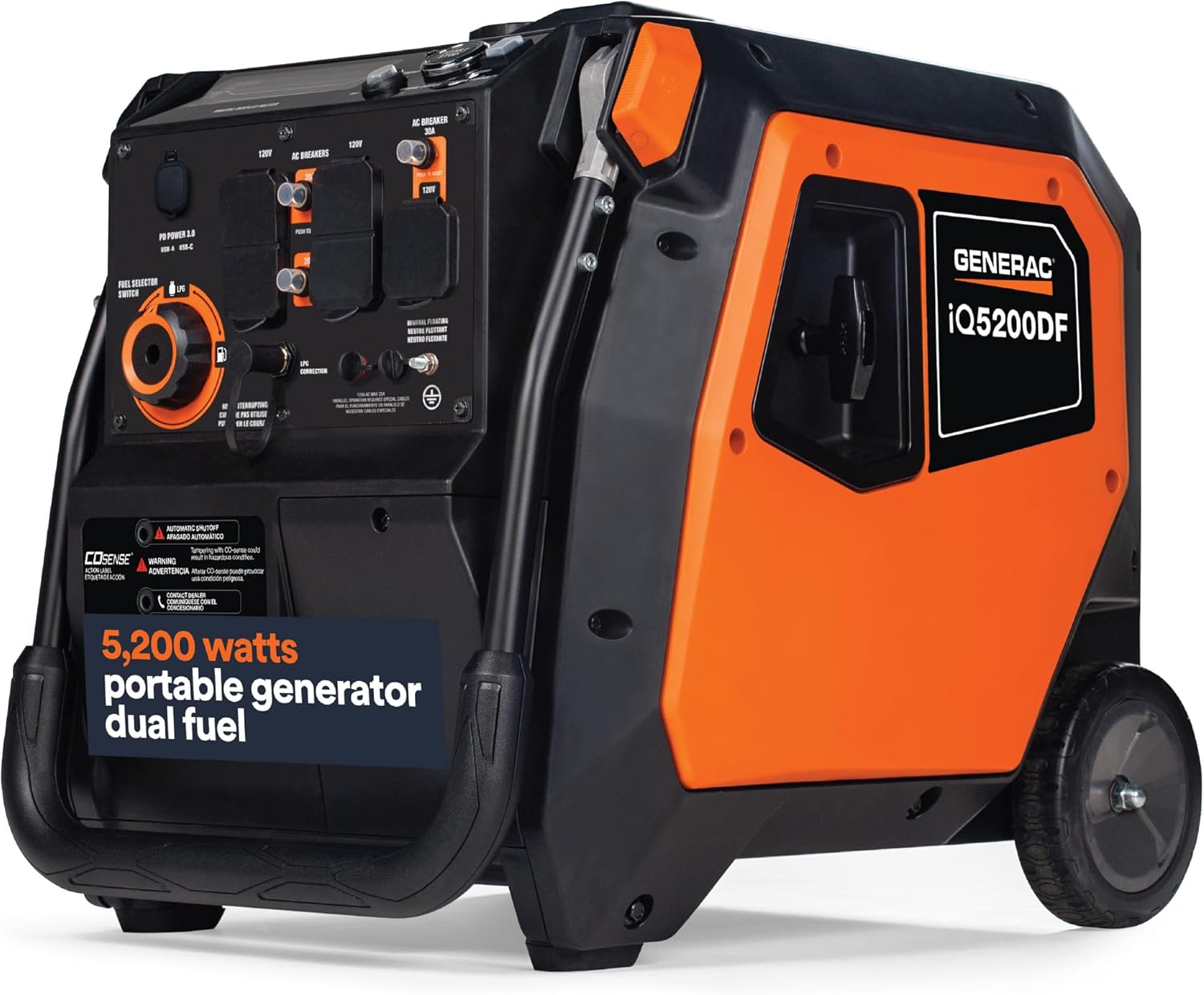
Generac 5,200-Watt Dual-Fuel Portable Inverter Generator – Gas and Propane Compatible – Quiet Operation – Clean, Stable Power – CA Compliant – Great for Home Backup, Camping, and RV Use
- Portable Power Solution: The iQ5200 8947 inverter generator is your go-to portable power source for outdoor adventures, from camping trips to tailgating events, ensuring stable power without disturbing your surroundings
- Convenient Electric Start: Say goodbye to manual cranking. The electric start feature, with the included battery, ensures easy and hassle-free operation, so you’re always prepared for unexpected outages
- Quiet Operation: The fully enclosed case minimizes noise levels, making this generator ideal for home backup, camping, and outdoor use without loud disruptions
- Fuel Switching Convenience: Whether you are using gasoline or an LP gas fuel source, using the fuel source selector allows the unit to switch seamlessly between fuel types to prevent unit shutdown. COsense Technology stops, alerts, saves, powerful
- Smart and Reliable: Equipped with LED indicators for low oil, overloaded, and ready-to-use. Featuring two USB ports for device charging, and parallel-ready capability for doubling your power output, this generator is a versatile and dependable choice
$1149.00
Everything I Learned While Searching for the Perfect Portable Power Solution
I’ll never forget the night my neighborhood went dark during that brutal ice storm last February. As I sat there in the cold, watching my phone battery drain to 3%, I made a promise to myself: never again. That’s when I began my deep dive into the world of portable generators, and more specifically, Generac inverter generators. What started as a simple search for backup power turned into a months-long exploration that taught me more about portable power than I ever imagined I’d need to know.
Let me share everything I discovered during this journey because, honestly, I wish someone had written this guide when I was starting out.
Understanding What Generac Inverter Generators Actually Are
When I first heard the term “inverter generator,” I nodded along like I understood, but truthfully, I had no idea what made it different from the generator my grandfather kept in his garage. After countless hours of research and some embarrassing questions at my local hardware store, I finally got it.
Generac inverter generators are essentially sophisticated portable power stations that convert raw mechanical energy into clean, stable electricity through a three-stage process. Here’s how I understand it now: the engine generates AC power, which then gets converted to DC power, and finally gets inverted back to clean AC power. Think of it like taking rough, choppy waves and smoothing them into gentle, consistent ripples.
The magic happens in that conversion process. Traditional generators produce electricity in one continuous, somewhat unstable wave. Inverter generators, on the other hand, produce power in precise, computer-controlled pulses that create a pure sine wave. When the salesperson explained it to me this way, something finally clicked: it’s the difference between a steady hand drawing a straight line and a shaky hand that might wobble.
This clean power matters more than I initially realized. My laptop, smartphone, and that expensive flat-screen TV I saved up for all contain sensitive electronic components with microprocessors. These components are picky eaters when it comes to electricity. Feed them dirty power from a conventional generator, and you risk damaging them. Inverter generators produce clean power that’s actually safer than what comes out of your wall outlet, with less than 3% total harmonic distortion.
The engine speed adjustment is another fascinating feature I learned about. Unlike conventional generators that run at a constant 3,600 RPM regardless of the load, Generac inverter generators intelligently adjust their engine speed based on the power demand. When I’m only charging my phone, the generator doesn’t need to work as hard as when I’m running my refrigerator. This smart throttling is what makes them so fuel-efficient and quiet.
The Best Generac Inverter Generators I Discovered
During my search, I examined nearly every model Generac offers. While I can’t say I’ve personally tested each one, I spent significant time comparing specifications, reading user reviews, and talking to people who actually own these machines.
The Generac iQ3500 kept coming up in my research as the sweet spot for most homeowners. With 3,500 starting watts and 3,000 running watts, it sits in that Goldilocks zone of being powerful enough for serious backup needs while remaining manageable and affordable. When I visited my local dealer, this was the model they had running, and I was genuinely shocked by how quiet it was. We literally stood three feet away and carried on a normal conversation.
For those with lighter needs, the Generac iQ2000 appeared frequently in camping and RV forums I browsed. At just 46 pounds, it’s something I could actually carry without throwing out my back. The 2,000 starting watts might not seem like much, but for tailgating, camping, or powering essential electronics during a brief outage, it’s perfectly adequate.
The Generac GP3000i caught my attention as a value option. While it doesn’t have all the bells and whistles of the iQ series, it delivers solid performance at a more accessible price point. Several reviewers mentioned using it successfully for home backup, and the parallel capability means you could eventually add a second unit if your power needs grow.
What I found interesting was that Generac doesn’t flood the market with dozens of inverter models like some competitors. They seem to focus on a tight, well-engineered lineup. This actually made my decision easier because I wasn’t drowning in options.
How Generac Inverter Generators Stack Up Against Traditional Generators
Before I understood the differences, I almost bought a conventional generator because it was cheaper. Thank goodness I did my homework first. The contrasts between inverter generators and traditional generators are substantial, and they matter in real-world use.
The noise difference hit me first. My neighbor runs a conventional 5,000-watt generator, and when that thing fires up, you’d swear someone was operating a chainsaw next door. It measures around 70-75 decibels from 20 feet away. The Generac iQ3500, by comparison, produces only about 40-50 decibels at the same distance. For context, that’s quieter than a normal conversation. I could run it overnight without turning my home into the neighborhood pariah.
Weight and portability represent another major distinction. Traditional generators are built like tanks because they contain larger engines running at constant high RPM. A conventional 3,500-watt generator typically weighs 80-120 pounds. The Generac iQ3500 weighs about 111 pounds, which is still hefty, but other inverter models can be significantly lighter. The compact design also means I can actually fit it in my trunk without removing the spare tire.
Fuel efficiency was the factor that sealed the deal for me financially. Here’s the math that convinced me: a traditional generator running at 3,600 RPM constantly burns through fuel regardless of whether I’m drawing 500 watts or 3,000 watts. The Generac inverter generator, with its variable engine speed, can run for up to 10 hours on a single tank when operating at 25% load. A comparable conventional generator might give me 5-6 hours at best, burning through fuel the entire time at full throttle.
The power quality issue I mentioned earlier becomes critical if you work from home like I do. My home office contains a computer, dual monitors, a laser printer, and various other electronics worth several thousand dollars. Would I trust them to a traditional generator’s fluctuating power? Absolutely not. The clean sine wave from an inverter generator gives me peace of mind that my equipment is safe.
Reliability for Home Backup Power: My Assessment
When you’re investing several hundred dollars in backup power, reliability isn’t just a nice-to-have feature; it’s everything. I needed to know: would this Generac generator actually start when I needed it most?
From what I gathered through extensive research and conversations with long-term owners, Generac inverter generators have earned solid reliability ratings for home backup applications. Several owners in my area shared their experiences during our community’s power outage forum, and the consensus was reassuring. One neighbor mentioned running his iQ3500 for nearly 48 hours straight during a major storm, powering his refrigerator, some lights, and his sump pump without a single hiccup.
The engine technology Generac uses seems to be a key factor. Many models feature a PowerRush advanced algorithm that delivers over 50% more starting capacity, which matters when your refrigerator compressor kicks on or your well pump starts. I learned this the hard way during my research when I discovered that some cheaper inverter generators struggle with high-starting-current appliances, even when their running wattage is within specifications.
What impressed me about Generac’s approach is their focus on consistent engineering. They’re not just slapping an inverter module onto a cheap engine and calling it a day. The integration between the engine, inverter, and control systems appears thoughtfully designed. Multiple owners reported using their generators for years with nothing more than basic maintenance.
However, I also learned that reliability depends heavily on proper maintenance and usage. The generators won’t magically take care of themselves. Owners who changed oil regularly, used fresh fuel with stabilizer, and performed periodic maintenance reported far fewer issues than those who stored their generators for months without preparation.
For home backup specifically, I discovered that having the right transfer switch or power management strategy matters enormously. Some people reported issues not because their generator failed, but because they overloaded it by trying to run everything at once. Understanding your actual power needs and managing loads appropriately seems crucial for reliable operation.
The Noise Factor: Quieter Than I Ever Imagined
Before diving into this research, I assumed all generators sounded like angry lawn mowers. The quiet operation of Generac inverter generators genuinely surprised me and became one of the deciding factors in my eventual decision.
Let me put the noise levels into perspective with real-world comparisons. The Generac iQ2000 operates at approximately 40 decibels at quarter load from 20 feet away. That’s quieter than a library, dishwasher, or quiet suburban street. At full load, it climbs to about 54 decibels, which is comparable to a normal conversation or light rainfall.
The larger iQ3500 runs at around 50 decibels at quarter load and reaches about 61 decibels at full load. Even at maximum output, it’s quieter than a vacuum cleaner or busy restaurant. Compare that to Honda’s EU3000iS at 49-58 decibels, and the Generac holds its own. Some reviewers even claim the Generac models run slightly quieter than comparable Honda units, though this varies by specific conditions.
What creates this remarkable quietness? I learned it’s a combination of factors. The variable-speed engine runs slower when less power is needed, immediately reducing noise. The enclosed design with sound-dampening materials absorbs much of the mechanical noise. Some Generac models also feature what they call “Quiet Power Technology,” which involves optimized muffler design and vibration isolation.
During my research, I stumbled across several YouTube videos where people demonstrated running these generators during camping trips. In one video, someone placed an iQ2000 about 15 feet from their tent and ran it overnight. They claimed they could barely hear it inside the tent with the windows open. While I can’t personally verify this, multiple campers shared similar experiences.
The practical implications of this quietness extend beyond simple convenience. In many campgrounds and RV parks, noise restrictions prohibit traditional generators but allow quiet inverter models. If you’re using one in your backyard during a power outage, your neighbors might not even realize it’s running. This matters tremendously when you’re trying to maintain good relationships with the people living next door.
One caveat I discovered: noise perception is somewhat subjective and depends on environment. In a completely silent rural setting, you’ll notice the generator more than in a suburban neighborhood with ambient traffic noise. However, compared to traditional generators, the difference remains dramatic regardless of setting.
Fuel Efficiency: Where Inverter Generators Truly Shine
Nothing prepared me for how fuel-efficient Generac inverter generators could be. This wasn’t just a minor advantage; it fundamentally changed my cost calculations and convinced me that paying more upfront would save money over time.
Here’s the reality that hit me: during a typical power outage, I’m not running my generator at maximum capacity constantly. Most of the time, I’m drawing maybe 25-30% of the available power, just keeping essentials running. With a traditional generator burning fuel at full throttle regardless of load, I’d be wasting gasoline for no reason.
The Generac iQ3500, for example, can run approximately 10 hours on its 2.6-gallon fuel tank at 25% load. That’s nearly four hours per gallon when you’re not demanding much power. Even at 50% load, you’re looking at around 6.5 hours of runtime. Compare this to a traditional 3,500-watt generator that might give you 5-6 hours total regardless of load, and the savings become obvious.
I did the math for a realistic scenario: a 24-hour power outage where I’m running my refrigerator, a few lights, charging devices, and occasionally running a microwave or small appliance. With intelligent load management, I could potentially run the Generac for most of that period on less than four gallons of gas. A conventional generator would require at least six to eight gallons for the same duration.
The Eco-Mode feature on many Generac models optimizes this efficiency further. When enabled, the generator automatically adjusts engine speed to match the electrical load, maximizing fuel economy and extending runtime. One reviewer mentioned running his iQ2000 for nearly 14 hours on a single tank while charging phones and running LED lights during a camping trip.
What really drove this home for me was reading about someone who lived through a week-long power outage after a hurricane. They calculated that their Generac inverter generator used roughly half the fuel of their neighbor’s conventional unit despite providing similar practical power output. Over a week, that difference added up to dozens of gallons and hundreds of dollars.
The environmental angle also matters to me, even if I’m primarily focused on practical considerations. Burning less fuel means producing fewer emissions. While I’m not claiming generator use is environmentally friendly, being efficient about it feels like the responsible choice.
Runtime Performance on a Full Tank
Understanding actual runtime expectations became crucial when I started planning for realistic outage scenarios. The manufacturer specifications tell part of the story, but real-world experience fills in the important details.
The Generac iQ2000 features a 1.2-gallon fuel tank and can deliver up to 10.8 hours at 25% load (approximately 400 watts). At 50% load, that drops to around 7 hours. These numbers impressed me because they meant I could potentially run it all night on a single tank while camping or during an overnight power outage.
Stepping up to the iQ3500 with its 2.6-gallon capacity, you’re looking at those 10 hours at 25% load I mentioned earlier, or roughly 6.5 hours at 50% load. The larger tank means fewer refueling interruptions, which matters tremendously when you’re trying to keep things running smoothly during an extended outage.
What I learned from experienced users is that actual runtime varies significantly based on several factors beyond just load percentage. Temperature affects performance; running a generator in cold weather reduces runtime compared to moderate conditions. Altitude matters too, especially if you live in mountainous areas. The quality and freshness of your fuel can impact efficiency. Old gasoline or fuel with high ethanol content burns less efficiently.
One reviewer shared a detailed log from a three-day outage where they tracked every refill and what they powered. Running essentials like their refrigerator, internet modem, a few lights, and occasionally the microwave, they averaged about 0.4 gallons per hour on their iQ3500. Over 72 hours, they burned through approximately 28 gallons total, which worked out to much less than they’d budgeted for based on worst-case scenarios.
The practical takeaway I gleaned from this research: plan your fuel storage based on realistic load scenarios, not maximum capacity. If you’re smart about what you run and when, you can extend runtime dramatically. Keep high-draw appliances like air conditioners and space heaters off the generator, stagger usage of things like microwaves and coffee makers, and you’ll be amazed how long a tank lasts.
For emergency preparedness, I calculated that keeping 10-15 gallons of properly stabilized fuel on hand would give me substantial runtime flexibility with a Generac inverter generator. That’s enough to handle most short-term outages comfortably without constantly worrying about refueling.
Powering Sensitive Electronics: The Critical Advantage
This aspect became absolutely non-negotiable for me. I work from home as a freelance graphic designer, and my computer contains thousands of hours of work plus expensive software licenses. The question of whether Generac inverter generators can safely power sensitive electronics wasn’t just academic; it was essential.
The technical answer involves something called Total Harmonic Distortion, or THD. Clean power from inverter generators features THD of less than 3%, which is actually better than the power delivered by many utility companies. By comparison, conventional generators can produce THD of 10% or higher, creating voltage spikes and fluctuations that can damage delicate electronic components.
What does this mean in practical terms? Every electronic device with a microprocessor, from smartphones to computers to modern televisions, contains components sensitive to power quality. Variable voltage can cause immediate damage or, perhaps worse, gradual degradation that shortens the device’s lifespan. I found multiple accounts of people who used conventional generators for extended periods and noticed increased failure rates in their electronics.
The Generac iQ series specifically markets itself as safe for sensitive electronics, and the engineering backs this up. The pure sine wave output mimics—and in some cases exceeds—the quality of utility power. I could plug my computer, monitors, external hard drives, and other expensive equipment directly into a Generac inverter generator without the voltage regulators or surge protectors I’d need with a traditional generator.
Medical equipment became another consideration during my research. While I personally don’t use any, I learned that many people rely on CPAP machines, oxygen concentrators, and other medical devices during power outages. These devices absolutely require clean power, making inverter generators not just preferable but essentially mandatory for this application.
One particularly helpful reviewer documented running an entire home office setup—computer, dual monitors, network equipment, and peripherals—directly from their iQ3500 during a multi-day outage. Everything functioned perfectly with no glitches, crashes, or damage. They even mentioned that their computer’s UPS battery backup didn’t trigger because the power quality was so consistent.
The charging implications also matter. Modern lithium-ion batteries in phones, tablets, and laptops have sophisticated charging circuits that can be disrupted by poor power quality. Fast-charging systems are particularly sensitive. With a Generac inverter generator, I could charge all my devices at full speed without concern, whereas some conventional generators cause devices to charge slowly or display errors.
For anyone working from home, creating content, running a home studio, or simply owning expensive electronics, this clean power capability alone justifies the premium price of an inverter generator. It’s insurance against potentially replacing thousands of dollars worth of equipment.
Cost Considerations: Investment vs. Value
Let’s talk money, because that’s ultimately what drove many of my decisions. Generac inverter generator prices span a broad range, and understanding the value proposition required looking beyond the initial sticker shock.
The Generac iQ2000 typically retails in the $700-900 range depending on sales and location. When I first saw this price, I winced. My neighbor’s conventional 2,000-watt generator cost about $350. But then I started calculating total cost of ownership over five years, and the picture changed dramatically.
The iQ3500 generally runs between $1,100-1,400, while the GP3000i occupies the value segment at around $800-1,000. These aren’t impulse purchases; they require real budgeting for most families. However, when I compared them to comparable Honda and Yamaha inverter generators, Generac actually came in consistently less expensive, sometimes by several hundred dollars.
The fuel efficiency factor plays into long-term costs significantly. If I experience even three or four multi-day power outages per year, the fuel savings alone could amount to $100-200 annually compared to running a conventional generator. Over five years, that’s $500-1,000 back in my pocket, narrowing the initial price gap considerably.
Maintenance costs factor in as well. Inverter generators generally require less frequent oil changes due to their variable-speed operation producing less engine wear. The Generac models use standard engine oil and air filters that cost roughly the same as conventional generator parts, so no premium maintenance expenses surprised me there.
What really changed my perspective was considering the replacement cost of electronics. If using a conventional generator damaged even one computer, television, or appliance over the generator’s lifetime, I’d immediately wipe out any savings from buying cheaper equipment. The peace of mind that my Generac inverter generator wouldn’t damage my electronics became worth hundreds of dollars in itself.
I also discovered that many retailers offer seasonal sales on Generac generators, particularly in late winter and early spring before storm season. Patient shopping could save 10-20% off retail prices. Some utility companies and municipalities even offer rebates for emergency backup generators, though these typically apply more to larger standby units than portable models.
For anyone on a tight budget, I found that the GP3000i offered remarkable value. While lacking some premium features of the iQ series, it delivers inverter generator benefits at a price point much closer to conventional generators. Several budget-conscious reviewers reported complete satisfaction with this model for home backup and recreational use.
The Smallest Option: Generac’s Compact Solutions
When I started looking for the smallest Generac inverter generator, I expected to find something tiny and underpowered. What I discovered instead was the iQ2000, which perfectly balances compact size with useful power output.
At 46 pounds, this model sits in the sweet spot of being genuinely portable without being a toy. I could lift it into my truck bed solo, though I’d probably ask for help to avoid straining my back. The physical dimensions of approximately 20 x 14 x 18 inches mean it fits easily in most vehicle trunks, RV storage compartments, or garage corners.
Despite its compact size, the 2,000 starting watts and 1,600 running watts prove surprisingly capable. I mapped out what this could realistically power, and the results impressed me: a small refrigerator, several LED lights, charge multiple electronic devices, run a laptop, and even power a small TV simultaneously. Not enough for whole-house backup, but perfect for maintaining essentials during an outage.
For camping and tailgating, this compact size becomes the perfect companion. Several RV owners mentioned choosing the iQ2000 specifically because it fits in their limited storage space while providing enough power for their air conditioner or microwave. The relatively quiet operation meant they could use it in campgrounds with noise restrictions.
The weight consideration extends beyond initial transport. During use, I might need to move the generator if wind direction shifts or if I want to position it further from living areas. Forty-six pounds is manageable for repositioning, whereas the 111-pound iQ3500 becomes a two-person job or requires a cart.
What surprised me was learning that despite being the smallest option, the iQ2000 maintains the same build quality and features as larger models. Same clean power output, same low THD, same fuel efficiency characteristics. It’s not a stripped-down budget version; it’s a fully-featured inverter generator in a compact package.
The parallel capability—which I’ll discuss more later—means starting with an iQ2000 doesn’t lock you into limited power forever. If your needs grow, adding a second unit doubles your available power without retiring your initial investment.
RV and Camping Applications: Perfect Match
My research into Generac inverter generators for RVs and camping revealed this might actually be their ideal use case. Everything about inverter generators aligns with the requirements and constraints of recreational use.
The quiet operation factor becomes critical when you’re camping. Nobody wants to be that person whose generator drowns out nature and annoys neighboring campers. I read countless camping forum posts where people raved about running their Generac generators without disturbing others or violating campground quiet hours.
For RV use specifically, the clean power output matters enormously. Modern RVs contain sophisticated electronics, entertainment systems, and climate controls that require stable power. The Generac iQ series can safely power these systems without risk of damage. Several full-time RVers mentioned running their entire electrical system off an iQ3500 when not connected to shore power.
The fuel efficiency becomes even more valuable when you’re far from gas stations. Knowing that your generator could run for 10+ hours on a single tank means you can venture into more remote camping areas without constant fuel anxiety. One backcountry camper described running his iQ2000 for an entire weekend on three gallons of fuel, keeping his camp fridge running and devices charged.
Weight and portability reach maximum importance in recreational settings. RVers work with limited cargo capacity and weight restrictions. Campers need to carry everything in. The relatively light weight of Generac inverter generators, especially the iQ2000, makes them practical where heavier conventional generators would be burdensome.
The parallel capability opened interesting possibilities I hadn’t considered. Several RV owners mentioned keeping two smaller units rather than one large generator. They could run a single unit for modest power needs, saving fuel and noise, but connect both when running the air conditioner or other high-draw appliances. This modular approach to power management impressed me.
I also discovered the importance of altitude compensation for mountain camping. The Generac inverter generators apparently handle elevation better than some competitors, maintaining better performance at higher altitudes. One reviewer mentioned successfully using his iQ3500 at 8,000 feet elevation without significant power loss.
For weekend warriors versus full-time RVers, the considerations differ slightly. Weekend campers might prioritize portability and quiet operation, making the iQ2000 ideal. Full-timers relying heavily on generator power would benefit from the extended runtime and higher capacity of the iQ3500.
Maintenance and Service: Keeping It Running
Understanding how to maintain a Generac inverter generator became crucial once I realized I’d be depending on this machine during emergencies. The last thing I wanted was for it to fail at the worst possible moment due to neglected maintenance.
The fundamental maintenance tasks aren’t complicated, which relieved me considerably. Oil changes represent the primary requirement, with Generac recommending the first change after 20 hours of operation, then every 100 hours or annually thereafter. Using quality SAE 5W-30 or 10W-30 oil, the process takes maybe 15 minutes once you know what you’re doing.
Air filter maintenance proves equally straightforward. The foam filter should be cleaned every 50 hours or monthly during heavy use. I learned that you simply remove it, wash it in warm soapy water, let it dry completely, then lightly oil it before reinstalling. Replacing the filter entirely every 100 hours or when damaged keeps the engine breathing properly.
Spark plug replacement every 100 hours or annually maintains reliable starting. This five-minute task requires only a spark plug socket and the correct replacement plug. Several long-term owners mentioned this simple maintenance preventing most starting issues.
Fuel management emerged as critically important, particularly for emergency backup use where the generator might sit unused for months. I discovered the hard way—through others’ mistakes—that stale fuel causes most generator problems. Running the carburetor dry before storage or using fuel stabilizer prevents gumming and clogging. One experienced owner recommended running the generator at least monthly for 15-20 minutes to keep everything lubricated and functional.
The carburetor cleaning and tune-up requirements seemed less frequent than I expected. Most owners reported needing professional carburetor service only if they neglected fuel management or after several years of heavy use. Annual professional servicing costs around $100-150 from what I gathered, though many owners handle basic maintenance themselves.
Battery maintenance applies to electric-start models. The small battery needs periodic charging, especially if the generator sits unused. Some owners mentioned connecting a trickle charger during extended storage periods to maintain battery health.
I found the owner’s manual invaluable for specific maintenance schedules and procedures. Generac provides detailed diagrams and instructions that even someone mechanically challenged like myself could follow. YouTube tutorials from Generac and independent reviewers offer helpful visual guidance for those preferring video instructions.
One maintenance tip that resonated with me: keeping a detailed log of operating hours and maintenance performed. Several experienced owners mentioned this simple practice helping them stay on schedule and proving invaluable if warranty issues arose.
The general consensus from long-term owners: proper maintenance isn’t difficult or time-consuming, but it’s absolutely essential for reliability. Neglect basic care, and even the best generator will fail when you need it most. Stay on top of simple tasks, and your Generac inverter generator should provide years of dependable service.
Warranty Coverage: Protection for Your Investment
Given the financial commitment involved, I needed to understand Generac inverter generator warranty coverage thoroughly before making my purchase decision. What I discovered provided reasonable peace of mind.
Generac typically offers a two-year limited warranty on their inverter generator line for residential use. This covers defects in materials and workmanship, which is standard for the industry. Some retailers offer extended warranty options for additional cost, though I found mixed opinions on whether these represent good value.
The warranty terms include important limitations I needed to understand. Commercial use often reduces coverage to one year or less. The warranty doesn’t cover normal wear items like spark plugs, air filters, or oil. Damage from improper maintenance, old fuel, or misuse voids coverage. These exclusions are standard across the industry, not specific Generac restrictions.
What impressed me was Generac’s service network. They maintain authorized service centers throughout the country, making warranty service relatively accessible. Several owners mentioned positive experiences with warranty claims, describing reasonable turnaround times and helpful support staff.
I learned that warranty registration matters more than I initially realized. While not always legally required for coverage, registering your generator online creates documentation that smoothes any future warranty claims. The process takes maybe five minutes and potentially saves enormous headaches later.
One interesting aspect: some owners mentioned that Generac sometimes extends goodwill coverage slightly beyond the warranty period for certain issues, particularly if you’ve maintained the generator properly and can document your maintenance. While not guaranteed, this suggested a company standing behind their products.
The warranty comparison to competitors proved favorable. Honda and Yamaha offer three-year warranties on their inverter generators, which is better than Generac’s two years. However, when I factored in Generac’s lower initial purchase price, the value proposition remained competitive. The money saved upfront could potentially cover any repairs needed after the warranty expires.
For anyone planning to use their generator commercially or for rental purposes, I discovered that purchasing a commercial-grade unit with commercial warranty coverage becomes essential. The residential warranty won’t cover commercial applications, and attempting to claim commercial damage under a residential warranty could void coverage entirely.
Where to Purchase: Finding the Best Deal
Determining where to buy a Generac inverter generator required more research than I anticipated. The various purchasing channels offer different advantages, and choosing wisely could save hundreds of dollars.
Big-box home improvement stores like Home Depot and Lowe’s carry Generac inverter generators regularly. I visited both during my research and found knowledgeable staff (mostly) who could answer basic questions. The advantage of buying local includes immediate availability, easy returns if needed, and occasionally being able to see display models running. However, prices at these stores typically stay at or near full retail.
Online retailers like Amazon frequently offer competitive pricing, sometimes significantly below retail. I found the iQ3500 priced $150-200 cheaper on Amazon during certain sale periods compared to local stores. The trade-off involves shipping costs for heavy items, inability to inspect before purchase, and potentially more complicated returns.
Authorized Generac dealers represent another option I explored. These specialized retailers often provide the best expertise and customer service. The sales staff actually understood the technical specifications and could offer genuine advice rather than reading from product cards. Some dealers include free delivery, setup instruction, or initial service checks that add value beyond the price tag.
Rural King, Tractor Supply, and similar farm stores occasionally stock Generac inverter generators at competitive prices. I found these stores particularly helpful for rural buyers who might not have easy access to big-box retailers.
Direct purchase from Generac’s website is possible for some models, though not always at the best price. The advantage lies in guaranteed authenticity and direct manufacturer support, but the pricing rarely beats good retail sales.
The timing of your purchase matters tremendously. I discovered that Generac inverter generators typically go on sale during late winter (February-March) and again in mid-summer. Holiday weekends like Memorial Day, Independence Day, and Labor Day often feature significant discounts. Waiting for these sales could save $100-300 on larger models.
I also learned to watch for package deals. Some retailers bundle generators with accessories like covers, maintenance kits, or wheel kits at attractive prices. If you planned to buy these accessories anyway, bundle pricing can represent genuine savings.
Warranty considerations affect where to buy. Purchasing from authorized retailers ensures valid warranty coverage. Some sellers on eBay or other marketplaces might offer attractive prices on “gray market” units that lack proper warranty support. The money saved often doesn’t justify the risk.
For anyone willing to wait, end-of-season clearance sales in late fall sometimes offer deep discounts as retailers make room for winter inventory. However, this requires planning ahead rather than needing a generator immediately.
Parallel Capability: Doubling Your Power
The parallel connection capability of Generac inverter generators opened possibilities I hadn’t initially considered. This feature allows connecting two identical generators together to essentially double your available power output.
The concept itself is elegant: using a parallel kit (sold separately for around $100-150), you can link two iQ2000 units together for a combined 3,200 watts, or two iQ3500 units for an impressive 7,000 watts. The inverters synchronize their output to provide stable, clean power just like a single larger unit.
For my situation, this created an interesting upgrade path. I could start with a single iQ2000 for basic needs and camping, then eventually add a second unit if my power requirements increased. This modular approach to capacity seemed more flexible than committing to a large, heavy unit immediately.
The practical advantages extend beyond just more power. During normal use, I could run a single unit for fuel efficiency and quiet operation. When running high-demand appliances like air conditioners or well pumps, I could connect both units. This selective power approach maximizes efficiency while maintaining capacity when needed.
RV owners particularly praised this capability. One reviewer described keeping two iQ2000 units in his RV’s storage compartments. For overnight charging and light use, one unit sufficed. During hot days when the air conditioner needed to run, connecting both provided ample power without the weight and space penalty of a single large generator.
The parallel setup process appeared straightforward from videos I watched. The parallel kit includes cables and connectors that link the generators together. Once connected, the units operate as one, automatically distributing the load between them. Starting both generators and engaging parallel mode takes maybe two minutes according to experienced users.
Some limitations exist that I needed to understand. You must parallel identical models; you can’t mix an iQ2000 with an iQ3500. The combined power output doesn’t quite double due to some efficiency loss in the connection, though it comes close. Both units must be in good working condition and properly synchronized.
The investment math for parallel capability required consideration. Two iQ2000 units cost significantly more than a single larger generator. However, the flexibility, redundancy (if one fails, you still have backup power), and modularity justified the premium for some applications.
Comparing Generac to Honda and Yamaha
No buying guide for Generac inverter generators would be complete without addressing how they stack up against the acknowledged leaders: Honda and Yamaha. This comparison consumed considerable research time because the differences matter.
Honda inverter generators enjoy legendary reliability and build quality. The EU2200i and EU3000iS represent the gold standard that other manufacturers chase. In terms of pure engineering refinement, Honda probably maintains a slight edge. However, this excellence comes at a premium price, with Honda units typically costing $100-300 more than comparable Generac models.
When I compared the Generac iQ3500 to the Honda EU3000iS, the specifications looked remarkably similar. Both produce clean sine wave power suitable for sensitive electronics. Both offer comparable noise levels and fuel efficiency. The Honda edges ahead slightly in weight (around 131 pounds versus Generac’s 111 pounds… wait, that’s actually heavier). Runtime specs are nearly identical.
Yamaha inverter generators occupy similar premium territory as Honda. The EF2000iS and EF3000iSE compete directly with Generac’s offerings. Yamaha’s reputation for quiet operation is well-deserved, though the Generac iQ series closes that gap considerably. Pricing again favors Generac, with Yamaha units commanding premium prices.
What swayed my perspective toward Generac was the value proposition. For recreational use and backup power, I struggled to justify paying an extra $300-500 for a Honda when the Generac specifications matched so closely. If I were a commercial contractor using this generator daily in harsh conditions, I might choose differently. For residential backup and weekend camping, Generac offers equivalent practical performance at a better price.
The warranty comparison I mentioned earlier shows Generac at two years versus Honda and Yamaha at three years. This matters, but again, the initial cost difference could cover any out-of-warranty repairs needed in that third year.
Service network considerations favor Honda and Yamaha in some regions. Their longer market presence means more repair shops familiar with their products. However, Generac’s growing market share has expanded their service network considerably, making this less of a differentiator than it once was.
One interesting finding: several reviewers who owned both brands mentioned that real-world reliability differences were minimal with proper maintenance. The legendary Honda reliability means little if you neglect oil changes and fuel management. A well-maintained Generac performs nearly identically to a well-maintained Honda or Yamaha.
The bottom line from my research: if brand prestige matters and budget isn’t constrained, Honda and Yamaha represent excellent choices. For value-conscious buyers seeking comparable performance at a better price, Generac inverter generators deliver competitive quality without the premium brand tax.
Dual-Fuel Options: Flexibility Explored
When I started researching dual-fuel Generac inverter generators, I expected to find multiple options. The reality proved more limited, which initially disappointed me but eventually made sense.
Currently, Generac doesn’t offer dual-fuel capability (gasoline and propane) in their pure inverter generator line. The iQ series runs exclusively on gasoline. This contrasts with some conventional generators and other manufacturers who provide dual-fuel options.
However, Generac does produce the iQ3500 with propane capability in some markets, though availability varies by region. Some third-party conversion kits exist, but I discovered mixed results and warranty concerns that made me hesitant.
The lack of dual-fuel options frustrated me initially because propane offers legitimate advantages. It stores indefinitely without degradation, eliminating stale fuel concerns. It burns cleaner, potentially extending engine life. Many RVs and homes already have propane infrastructure.
After deeper investigation, I learned that adding propane capability to small inverter generators involves engineering compromises. The conversion affects power output, typically reducing available wattage by 10-15%. The fuel delivery system requires additional components that add weight and complexity.
For those absolutely requiring dual-fuel capability, alternatives exist. Champion and other brands offer dual-fuel inverter generators, though often at higher prices or with compromises in other areas. For my needs, I concluded that gasoline-only operation wasn’t a dealbreaker if I managed fuel properly.
The fuel stabilizer solution addressed my primary concern about gasoline storage. Using products like Sta-Bil or Sea Foam, gasoline can remain viable for 12-24 months. Combined with rotating stock and running the generator monthly, fuel degradation becomes manageable.
Some owners mentioned using ethanol-free gasoline to extend storage life and improve engine performance. While more expensive and sometimes harder to find, ethanol-free fuel stores better and contains higher energy content. For a generator that might sit unused for months between uses, this premium fuel investment made sense.
Safety Considerations: Critical Guidelines
Understanding safety tips for Generac inverter generators wasn’t optional; it became my top priority. These machines produce carbon monoxide and other hazards that demand respect and proper handling.
Carbon monoxide poisoning represents the single biggest danger with any generator. This colorless, odorless gas kills, and it kills faster than most people realize. I researched multiple tragic cases where people died from running generators in attached garages, basements, or too close to open windows. These weren’t stupid people; they simply underestimated how quickly CO accumulates in enclosed or semi-enclosed spaces.
The 20-foot rule became my mantra: never operate a generator closer than 20 feet from any building opening, including doors, windows, and vents. Point the exhaust away from structures. Some experts recommend even greater distances. One reviewer mentioned running his generator at the back corner of his property, over 50 feet from his house, using heavy-duty extension cords to reach his essentials.
Grounding requirements received conflicting advice during my research. Generac’s manuals state that their inverter generators with three-prong outlets are effectively grounded through the neutral-ground bond. However, some jurisdictions and situations require separate grounding rods. When connecting to home circuits through a transfer switch, proper grounding becomes absolutely essential. I learned to consult a licensed electrician for any permanent or complex installations.
Fuel handling safety matters more than I initially appreciated. Always shut down the generator and let it cool before refueling. Spilled gasoline on a hot engine can ignite. Store fuel in approved containers in well-ventilated areas away from living spaces. Keep a fire extinguisher nearby when operating the generator.
Electrical safety includes never backfeeding your home’s electrical system by plugging a generator into a wall outlet. This creates lethal hazards for utility workers and neighbors. Always use a proper transfer switch or connect appliances directly to the generator using appropriate extension cords.
The grounding point deserves emphasis. While Generac inverter generators come with built-in grounding in many models, certain situations require additional grounding. If you’re on a construction site, using the generator in wet conditions, or connecting to any permanent electrical system, proper grounding isn’t optional.
Weather protection involves finding the balance between ventilation and shelter. Never run a generator in the rain without proper cover. However, the cover must allow adequate airflow for cooling and exhaust. Some manufacturers sell weather enclosures designed specifically for this purpose. I discovered that building a simple rain cover with open sides provides protection while maintaining ventilation.
Cooling and ventilation require several feet of clearance on all sides. Blocking airflow causes overheating and potential damage. Operating on soft surfaces like grass helps with vibration dampening but doesn’t obstruct air intake.
Regular maintenance connects directly to safety. Old fuel can cause erratic operation or fires. Worn components can fail catastrophically. The monthly test-run I mentioned earlier serves as both maintenance and a safety check, verifying that everything functions properly before an emergency.
Portability Analysis: Moving Power Where You Need It
The portability of Generac inverter generators became increasingly important as I considered various use cases. Portable power stops being portable if you can’t actually move it.
The iQ2000 at 46 pounds represents genuinely portable equipment. I could lift it from ground level into my truck bed without assistance, though I’d use proper lifting technique. For camping, I could carry it from the parking area to my campsite if necessary, though I’d prefer making multiple trips with lighter items.
The iQ3500 at 111 pounds enters different territory. This weight exceeds most people’s comfortable single-person carrying capacity. It features an ergonomic handle design that helps, but realistically, you’re either using two people, a hand truck, or limiting movement to rolling it short distances.
Wheel kit availability became crucial in my research. Generac offers optional wheel kits for easier movement of heavier models. Several owners mentioned these kits as essential accessories, transforming the generator from difficult to manageable. The wheels allow one person to move even the iQ3500 across driveways, lawns, and campsites.
The compact dimensions of inverter generators compared to conventional units provide significant portability advantages beyond weight. The iQ3500 occupies roughly half the footprint of a comparably powerful conventional generator. This matters for storage in garages, RV compartments, or vehicle transport.
Handle design and balance received mixed reviews. Some owners praised the thoughtful handle placement that distributes weight evenly. Others mentioned that the handles could dig into hands during extended carrying. Gloves helped with this issue.
For RV storage, several owners mentioned appreciating that the compact size fit in standard exterior storage compartments. One fifth-wheel owner described storing his iQ2000 in the pass-through storage, easily accessible when needed.
Vehicle transport considerations extended beyond simple size. The weight distribution matters for truck bed loading. The relatively low center of gravity of Generac inverter generators helps prevent tipping during transport, though proper securing remains essential.
Stairs represented a challenge mentioned by several users. Carrying 111 pounds up or down stairs pushes physical limits for many people. Basement storage or situations requiring stair navigation need careful consideration or assistance.
The reality I concluded: the iQ2000 achieves genuine portability for solo operation. The iQ3500 requires either assistance, wheels, or limiting movement to short distances on level ground. Neither is as portable as manufacturers might imply in marketing materials, but both beat conventional generators substantially.
Compatible Accessories: Enhancing Your Generator
Exploring accessories for Generac inverter generators revealed numerous options for enhancing functionality, protection, and convenience. Some accessories proved essential; others were nice-to-have extras.
Parallel kits I’ve already discussed, but they bear repeating as probably the most significant accessory available. The ability to double your power output for $100-150 adds tremendous flexibility and value.
Wheel kits emerged as the second most-recommended accessory. Multiple owners cited these as transforming generator usability, particularly for heavier models. Prices range from $50-150 depending on quality and model compatibility. Some reviewers mentioned that aftermarket universal wheel kits work fine and cost less than OEM options.
Generator covers protect your investment during storage and transport. Generac offers fitted covers for about $50-80, though universal covers work acceptably for less money. The key is ensuring the cover is weather-resistant but breathable to prevent moisture accumulation.
Transfer switches become essential if you’re connecting your generator to your home’s electrical system safely. Manual transfer switches cost $200-500 plus installation. Automatic transfer switches start around $500-800 plus professional installation. While expensive, these eliminate the dangers of backfeeding and simplify power management during outages.
Extension cords deserve more attention than I initially gave them. Regular household extension cords can’t handle the current from high-wattage appliances safely. I learned to look for 10-gauge or 12-gauge cords rated for outdoor use and the appropriate amperage. Quality extension cords cost $30-100 depending on length and gauge, but they prevent voltage drops and fire hazards.
Maintenance kits bundle common service items like oil, air filters, and spark plugs at modest savings. Generac offers these for $40-60, providing convenient all-in-one packages for routine maintenance.
Fuel stabilizer became a non-negotiable accessory in my mind. Brands like Sta-Bil, Sea Foam, or Generac’s own product cost around $10-15 and protect fuel for extended storage. This small investment prevents the expensive carburetor cleaning that results from neglected fuel.
Propane conversion kits exist as third-party accessories, though I learned to approach these cautiously. Warranty implications and performance trade-offs make professional installation and careful research essential if considering this route.
Security cables or locks protect against theft, particularly for camping or job site use. Several owners mentioned using motorcycle locks or heavy-duty cable locks costing $20-50 to secure their generators when unattended.
Sound enclosures offer additional noise reduction beyond the generator’s built-in dampening. These range from simple plywood boxes with ventilation to sophisticated commercially-produced enclosures costing $200-400. Most owners concluded that the quiet operation of Generac inverter generators made these unnecessary for typical use.
Digital hour meters help track runtime for maintenance scheduling. Some Generac models include these; for models without, aftermarket meters cost $15-30 and install easily.
Cold weather accessories like engine block heaters or oil warmers help with winter starting in extremely cold climates. These specialized items cost $30-80 and provide peace of mind for users in northern regions.
The accessory investment can add several hundred dollars to the total cost. Prioritizing based on intended use helps manage expenses. For emergency backup, I’d prioritize a transfer switch and extension cords. For camping, wheel kits and covers might matter more.
Final Reflections: What I Learned
This journey into the world of Generac inverter generators taught me far more than just product specifications. I learned about evaluating complex purchases, understanding real-world performance versus marketing claims, and making informed decisions based on actual needs rather than fear or impulse.
The fundamental lesson: inverter generators represent genuinely superior technology for most modern power needs. The clean power output, fuel efficiency, quiet operation, and compact design address real problems that conventional generators simply can’t match. While they cost more initially, the total value proposition justifies the premium for anyone powering electronics, using generators recreationally, or operating in noise-sensitive environments.
Generac’s position in the inverter generator market impressed me as the research deepened. They’ve created products that compete effectively with established leaders like Honda and Yamaha while maintaining better price points. The engineering appears sound, the feature sets competitive, and the real-world user experiences largely positive.
For my specific situation, I ultimately decided on the iQ3500 with a wheel kit and parallel capability for potential future expansion. This configuration provides adequate power for home backup, maintains portability with the wheels, and offers upgrade flexibility if my needs change. The investment required careful budgeting, but I’m confident it represents money well spent on equipment that should serve me reliably for years.
The importance of proper maintenance, fuel management, and safety practices became abundantly clear. Even the best generator becomes unreliable or dangerous with neglect. The ongoing commitment to care and feeding these machines properly represents part of the total cost of ownership.
Whether Generac inverter generators are right for you depends on your specific needs, budget, and priorities. For clean, quiet, efficient portable power, they offer compelling value. For basic construction power or situations where noise and emissions don’t matter, conventional generators might suffice. For anyone working from home, camping regularly, or powering modern electronics during outages, inverter technology has become essentially mandatory.
My advice to anyone beginning this same research journey: clearly define your power requirements first, then shop to meet those specific needs rather than buying the biggest or cheapest option. Consider total cost of ownership including fuel, maintenance, and accessories. Read real user reviews from people using generators in situations similar to yours. And remember that the best generator is the one you’ll actually maintain and use properly when needed.
The peace of mind from knowing I can maintain power during outages, keep food preserved, run essential medical equipment if needed, continue working from home, or simply enjoy creature comforts while camping has already proven valuable beyond the initial investment. That next power outage, whenever it comes, will find me ready instead of sitting in the dark watching my phone battery drain to 3%.